Upload a handwriting sample, see what is actually breaking legibility, and decide whether the next fix is line control, cleaner print, smoother cursive, or italic refinement. New accounts get one free handwriting check after sign-in. The free check is a limited preview; Full Reports add target font recommendations with a direct handoff into matching practice.
New accounts get one free handwriting check after sign-in · Diagnose first, then move into matched practice
Find the blocker
See whether spacing, baseline, size, or stroke control is the real issue.
Choose the target font
Unlock print, cursive, and italic targets tied to your writing tendency.
Start the right drills
Move into matched practice only after the report sets the training order.
AI handwriting analysis is a computer vision tool that evaluates five core dimensions of writing quality — legibility, consistency, fluency, structure, and pen control — to generate targeted diagnostic feedback and improvement guidance. Unlike graphology or personality analysis, this tool focuses purely on the mechanical quality of handwriting to help students, teachers, and adults improve writing clarity.
The system has analyzed over 3,000 handwriting samples and achieves an 87% user satisfaction rate based on real user feedback. It detects up to 6 handwriting issues per report including letter formation errors, spacing inconsistencies, and size variations to produce a visual issue map and 5-dimension radar chart. The full report then turns diagnosis into practice direction by recommending target fonts and clarifying whether stroke-control work should come before font-specific copying.
3,000+
Handwriting samples analyzed
87%
User satisfaction rate
Up to 6
Issues detected per report
5
Core evaluation dimensions
Analysis is based on computer vision evaluation of geometric shapes and spatial distribution patterns — not graphology or personality assessment.
Analysis Preview
What does the AI handwriting evaluation include?
Our model detects over 40 distinct metrics in every sample. We look beyond the surface to understand the mechanics of the hand movement and muscle memory.
Letter baseline drift detection
Inconsistent kerning and spacing analysis
Pressure-point mapping (AI estimation)
Letter Formation Errors
Ambiguous characters like a and o appear when bowls stay open or strokes finish inconsistently.
Consistency & Spacing
Irregular gaps and uneven rhythm make words harder to scan smoothly from left to right.
How It Works
How does the AI handwriting analysis work?
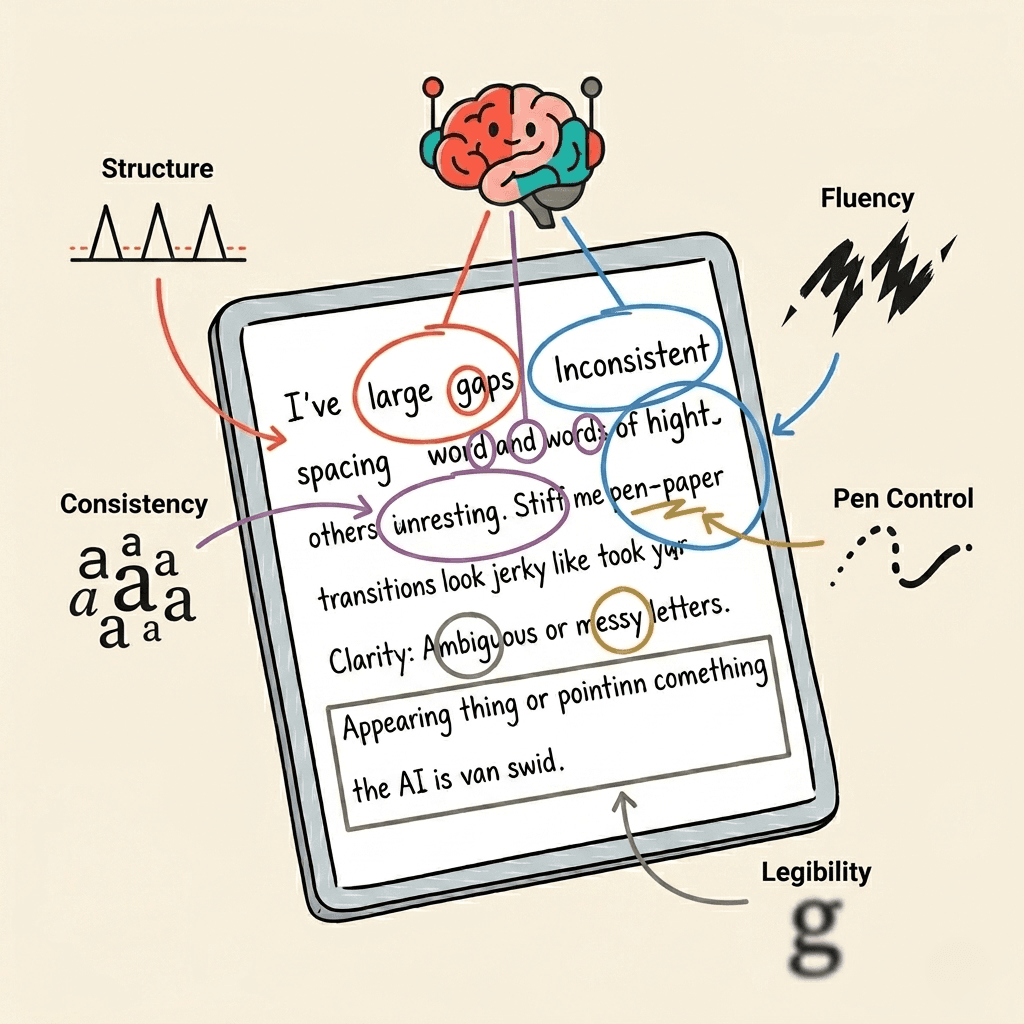
Legibility
Measures how easily individual characters can be recognized.
Consistency
Checks for uniform letter size and slant throughout the text.
Fluency
Evaluates the smoothness of connections between letters.
Structure
Assesses margin alignment and overall spatial layout.
Pen Control
Estimates motor skill stability and stroke confidence.
Detected Issues
What are common handwriting problems detected?
Baseline Drift
Baseline drift occurs when letters consistently rise above or fall below the expected horizontal writing line. This creates an uneven visual texture that forces readers to re-track their eyes vertically, slowing reading speed and reducing fluency. The AI detects this by measuring the vertical deviation of letter stems and descenders relative to a calibrated baseline, flagging samples where drift exceeds acceptable thresholds for the detected font style.
Spacing Issues
Inconsistent spacing between letters and words is one of the most common causes of illegible handwriting. When inter-letter gaps vary widely — with some letters nearly touching and others spaced too far apart — the brain must work harder to parse words. The AI quantifies both inter-letter and inter-word spacing variance, reporting a composite spacing score alongside specific zones where crowding or spreading is most pronounced.
Size Variation
Letters of different sizes within the same sample reduce visual consistency and signal poor motor control or rushing. The AI measures the bounding-box height of each character and computes a coefficient of variation across the entire sample, flagging instances where uppercase letters, lowercase letters, or descenders deviate significantly from the norm. Even subtle size inconsistencies — as small as 10–15% variation — can measurably impact readability scores.
Full Report
What does a handwriting evaluation report include?
Visual Issue Map
Highlighted stroke errors and line annotations mapped directly onto your uploaded handwriting sample. See see sample report.
5-Dimension Scores
Detailed score breakdowns across legibility, consistency, fluency, structure, and pen control. See see sample report.
Kinematic Findings + Target Font Direction
Process findings evaluating stroke speed variations, pen flow rhythm, and mechanical tremor stability, plus style-aligned target font direction for focused drills. See see sample report.
Recommendation Logic
How does AI choose your target fonts?
Where do the recommended practice fonts come from?
Our recommendation library combines carefully selected Google Fonts and independent handwriting-focused font sources. We avoid decorative-only scripts and prioritize letter clarity, stable rhythm, readable joins, and repeatable stroke patterns suited for real daily writing practice.
How does AI choose your target fonts?
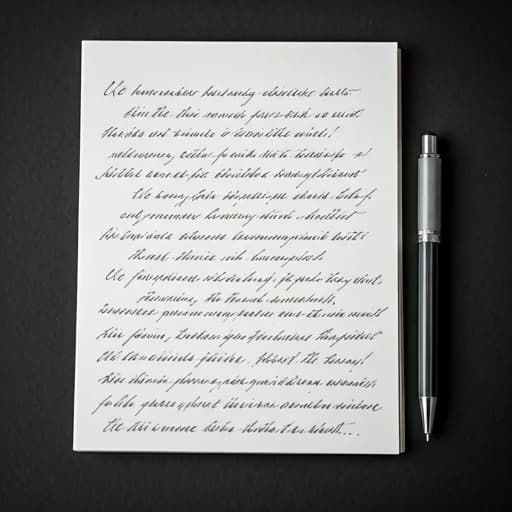
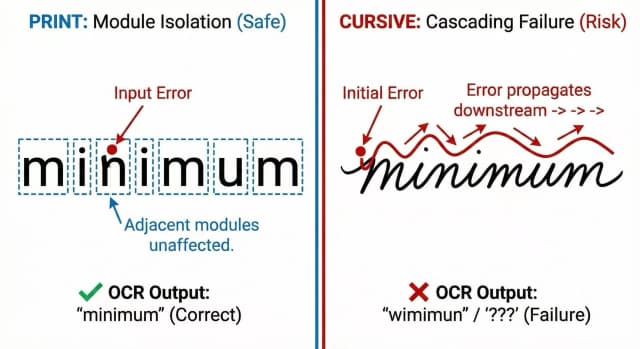
The model first extracts handwriting topology from your sample, then analyzes trajectory signals including continuity, curvature, slant flow, and spacing rhythm. It classifies your tendency as joined, unjoined, or mixed, then returns best-fit targets across print, cursive, and italic groups.
Why are some recommended fonts not shown in free worksheet pages?
Free worksheet pages intentionally use a smaller universal font set for quick setup. Full-report recommendations may include advanced training fonts tuned for correction goals, so users get simpler free access while retaining higher-precision guidance when they unlock.
What happens after you choose a recommended font?
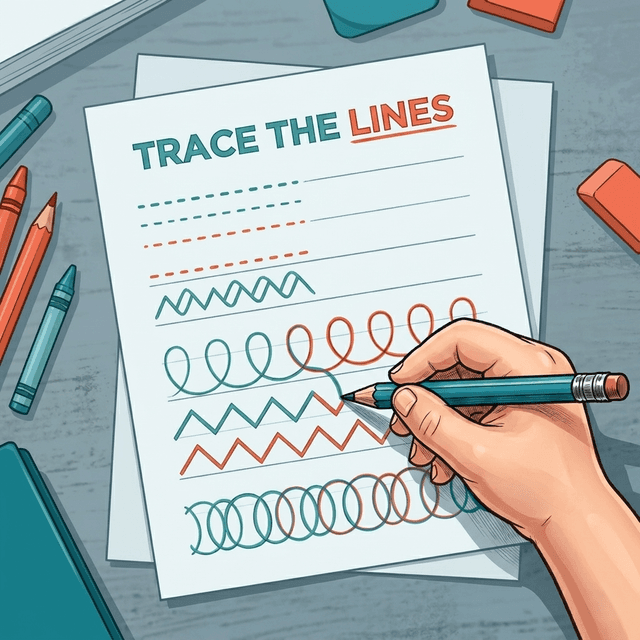
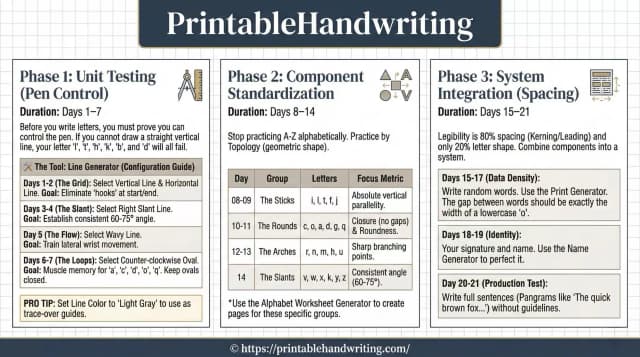
After selecting a target font, you move into a practice flow that keeps visual forms consistent with your correction goal. If your report flags foundational stroke issues first, you get line-drill guidance before font-specific copying so training order stays effective.
Recommended Fonts
What fonts are recommended after handwriting analysis?
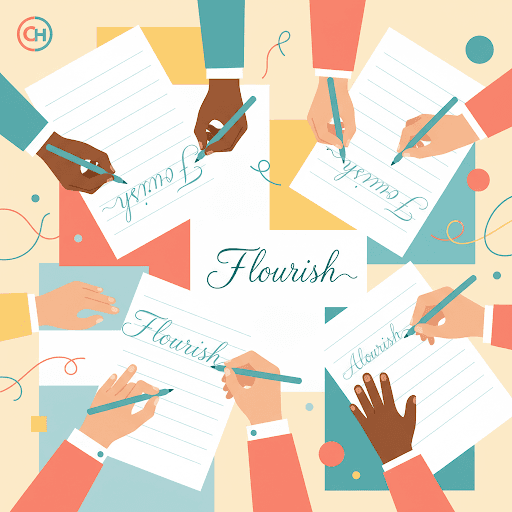
Full reports return nine target fonts in total: three print, three cursive, and three italic. Each recommendation includes a reason tied to your writing profile and a direct path into matching practice.
Pick one target font and continue with a locked visual model so your drills stay aligned with the correction path recommended by the report.
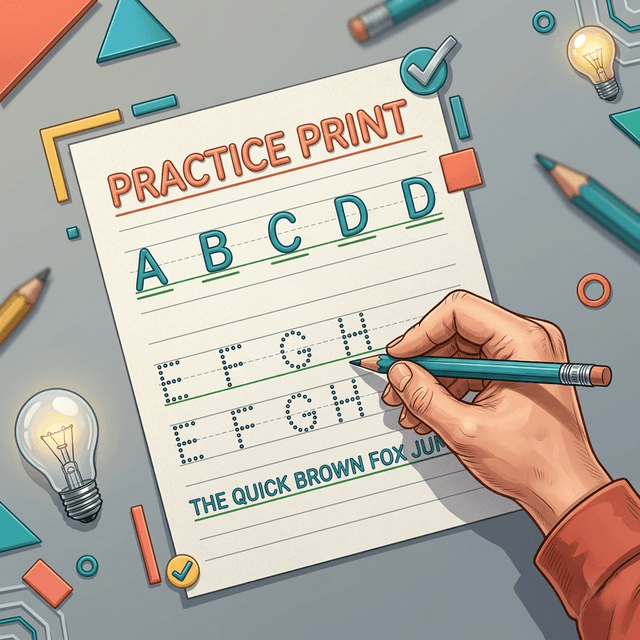
Print Style
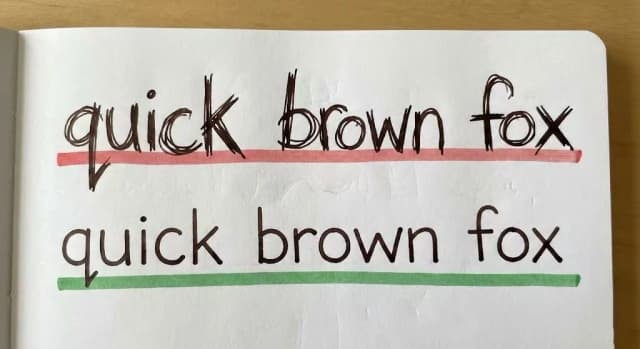
The quick brown fox
Print Style / Handwriting
Print Targets (3 Fonts)
Example print directions a full report can recommend when baseline drift, spacing crowding, or size instability is the main blocker.
The AI evaluation is based on computer vision analysis of geometric shapes and spatial distribution patterns. The system evaluates five core dimensions — legibility, consistency, fluency, structure, and pen control — by measuring features such as baseline alignment, letter spacing, stroke continuity, slant angle, and size uniformity across the submitted handwriting sample.
How the AI processes your sample
Each uploaded image is processed to extract over 40 distinct metric scores that together form a comprehensive handwriting profile. Based on real user feedback, the system achieves an 87% satisfaction rate. Every report includes plain-English explanations of detected issues and prioritized, actionable steps for improvement.
What the report gives you
While not a replacement for professional occupational therapy evaluation, the tool provides a reliable, accessible baseline for self-improvement, guided practice, and measurable progress tracking over time.
“The feedback was specific enough to know exactly what to fix first. My print is noticeably cleaner after three weeks.”
— Verified User, Adult Learner
“I tested it on several examples, including some of my own handwriting, and believe the judgments made by Xin Wan’s AI system to be excellent.”
Kate also noted that Xin Wan’s engineering perspective on handwriting structure is “clear and refreshing,” and that his analyses are “highly relevant” to academic research on handwriting movement efficiency and structural design.
Shared with permission from Kate Gladstone. pen.guide
Trust and Scope
Is this AI handwriting analysis for personality?
No. We focus exclusively on mechanical legibility and educational progress. While traditional graphology claims to predict personality, our tool is built on pedagogical research to improve writing clarity.
We use computer vision to analyze geometric shapes and spatial distribution, providing a scientific baseline for teachers and self-learners.
Analysis Requirements
Plain white or lined paper (A4/Letter size recommended)
Clear, top-down photo with uniform lighting
Use dark ink (Black or Dark Blue) for best AI detection
Your handwriting sample is never shared or used for any other purpose.
Free check previews and their uploaded images are kept for one month, then deleted.
The worksheet tools are free to use without an account. New accounts get one free handwriting check after sign-in. Your free check includes an overall score, one dimension preview, and one visual issue preview. It is a limited preview, not a Full Report. Free check previews are available for one month from creation; their uploaded images are deleted with the report after that period.
Free Handwriting Check
One free check for each new account after sign-in
$0
Overall handwriting score (0-100)
One dimension score preview
First writing issue with visual annotation on your sample
AI target font recommendations with direct practice handoff
—
Detailed mechanical explanations per issue
—
Full diagnostic report PDF export
—
Per-analysis cost
Free for new accounts after sign-in
From $0.99 with credits
Pricing
How much does a full handwriting report cost?
Full reports cost $3.99 individually, or as low as $0.99 per analysis with report packages. Unlocks are one-time purchases with no subscription fees and remain available until redeemed. Choose from Light ($9.99/3 unlocks), Standard ($24.99/10), Advanced ($49.99/25), Teacher ($129.99/100), or Teacher Plus ($299.99/300) packages.
New accounts get one free handwriting check after sign-in. Full Reports start at $3.99.
FAQ
Frequently Asked Questions
Are the worksheet generators free?
Yes. You can create, preview, and download custom worksheets without an account, payment, or credit card. Ready-made PDFs in the Practice Library are also free to download. Creating an account is only needed if you choose the optional AI handwriting check. New accounts get one free handwriting check after sign-in; Full Reports are a separate optional purchase.
What does the free handwriting check include?
A free handwriting check includes an overall score, a preview of your top dimension, and your core issue summary. It is a limited preview, not a Full Report. It is available for one month from creation, after which the report and its uploaded image are automatically deleted. Unlock for $3.99 (or 1 credit) to see the full radar chart, all 5 dimension details, every writing issue, practice tips, 9 AI target font recommendations, and a locked-font practice handoff.
How long is my free check preview available?
Free check previews and their associated uploaded images are retained for one month from creation, then automatically deleted. Unlock the Full Report before that time to keep it in your report history.
How much does a full report cost?
Full reports cost $3.99 for a single unlock. Credit packages bring the per-report cost as low as about $0.99. Credits are one-time purchases with no subscription fees and never expire. See the pricing page for package details.
Is this AI handwriting analysis for personality?
No. This tool does not perform graphology or personality interpretation. It focuses exclusively on physical writing quality metrics: legibility, consistency, fluency, structure, and pen control. The goal is actionable mechanical improvement feedback, not personality or character claims.
Do I need to pay for a handwriting check?
No. New accounts get one free handwriting check after sign-in, with an overall score, a top-dimension preview, and your core issue summary. It is a limited preview, not a Full Report. After the free check, Full Reports unlock from $3.99 or via credit purchases.
What sample format do I need to upload?
Upload a clear photo or scan (JPG, PNG, or WebP) of your handwriting on plain paper. Use good lighting without harsh shadows, fill most of the frame with the paper, and aim for at least 1024×768 resolution. Avoid flash to prevent glare.
How long does the analysis take?
Free handwriting check results are ready within 5–15 seconds of uploading. Full Reports generate immediately after payment confirmation, including all issue categories, detailed scoring, and complete diagnostic breakdowns.
Can I analyze someone else's handwriting?
Yes, with their permission. Parents frequently analyze children's writing development, and teachers use it to track student progress. The analysis evaluates physical writing quality the same way regardless of whose handwriting is submitted.
What makes this different from graphology or personality analysis?
This tool evaluates only measurable writing mechanics — letter spacing, baseline stability, stroke fluency, size uniformity, and pen control — then generates specific, actionable training recommendations. It does not interpret personality, emotional states, or character traits.
Do I need a subscription?
No subscription is required. Credits are one-time purchases that never expire. Each credit unlocks one full report. After unlocking, you can practice using our free worksheet generators indefinitely without additional payments.
Does the full report include AI-recommended practice fonts?
Yes. The full report includes AI-recommended target fonts matched to your writing profile and issue pattern. Recommendations are grouped by print, cursive, and italic styles so you can choose a direction that fits your current handwriting mechanics and then move straight into matching worksheet practice.
How many fonts do I get and how are they grouped?
You get nine target fonts in total: three print, three cursive, and three italic. Each recommendation includes a reason tied to your handwriting topology, spacing rhythm, slant behavior, and stroke continuity profile.
Why do free worksheet pages not show every recommended target font?
Free worksheet pages keep a smaller universal font set so setup stays fast and the interface stays simple. The full report can recommend a more precise target font set because it already knows your handwriting tendency, issue pattern, and likely correction path.
Can I practice directly after choosing a recommended font?
Yes. After selecting a recommended font, you can jump into matching worksheet practice immediately. If your report identifies foundational stroke-control blockers first, it will also suggest line-drill preparation before font-specific copying.
Will the report tell me if I should start with line drills before a font-specific worksheet?
Yes. When stroke continuity, baseline control, or basic trajectory smoothness is the bigger blocker, the report can point you to line-drill work before it recommends font-specific copying. That helps keep practice order aligned with the actual problem instead of guesswork.
New accounts get one free handwriting check after sign-in. Full Reports start at $3.99.