Quick Answer
How long does it take to improve handwriting?
There is no universal magic number for handwriting change. This 21-day challenge is best treated as a practical 3-week schedule: first build pen control, then practice letter families, then move to words and sentences.
Why Does the 21-Day Handwriting Plan Work?
A common misconception is that handwriting is about "style." It is not. It is a fine motor skill governed by biomechanics.
According to Fitts's Law, the time required to rapidly move to a target area is a function of the ratio between the distance to the target and the width of the target.
Translation: When you write fast (high speed), your accuracy (hitting the target shape) drops explicitly unless your muscle memory is automated.
The important part is the structure, not the number 21 itself. Research reviews on handwriting intervention show that progress depends on task-specific practice repeated over time, often across multiple weeks rather than through a single fixed threshold[Hoy et al., 2011] [Cahill et al., 2018].
This protocol forces you through the three stages of Motor Learning:
- Week 1 (Cognitive Stage): Consciously debugging line stability.
- Week 2 (Associative Stage): Grouping letters by geometric topology.
- Week 3 (Autonomous Stage): Focusing on flow and spacing (System Integration).
What Does the 21-Day Schedule Look Like?
Think of this as a simple practice sprint, not a promise of permanent motor memory by Day 21. If you miss a day, resume where you left off instead of starting over.
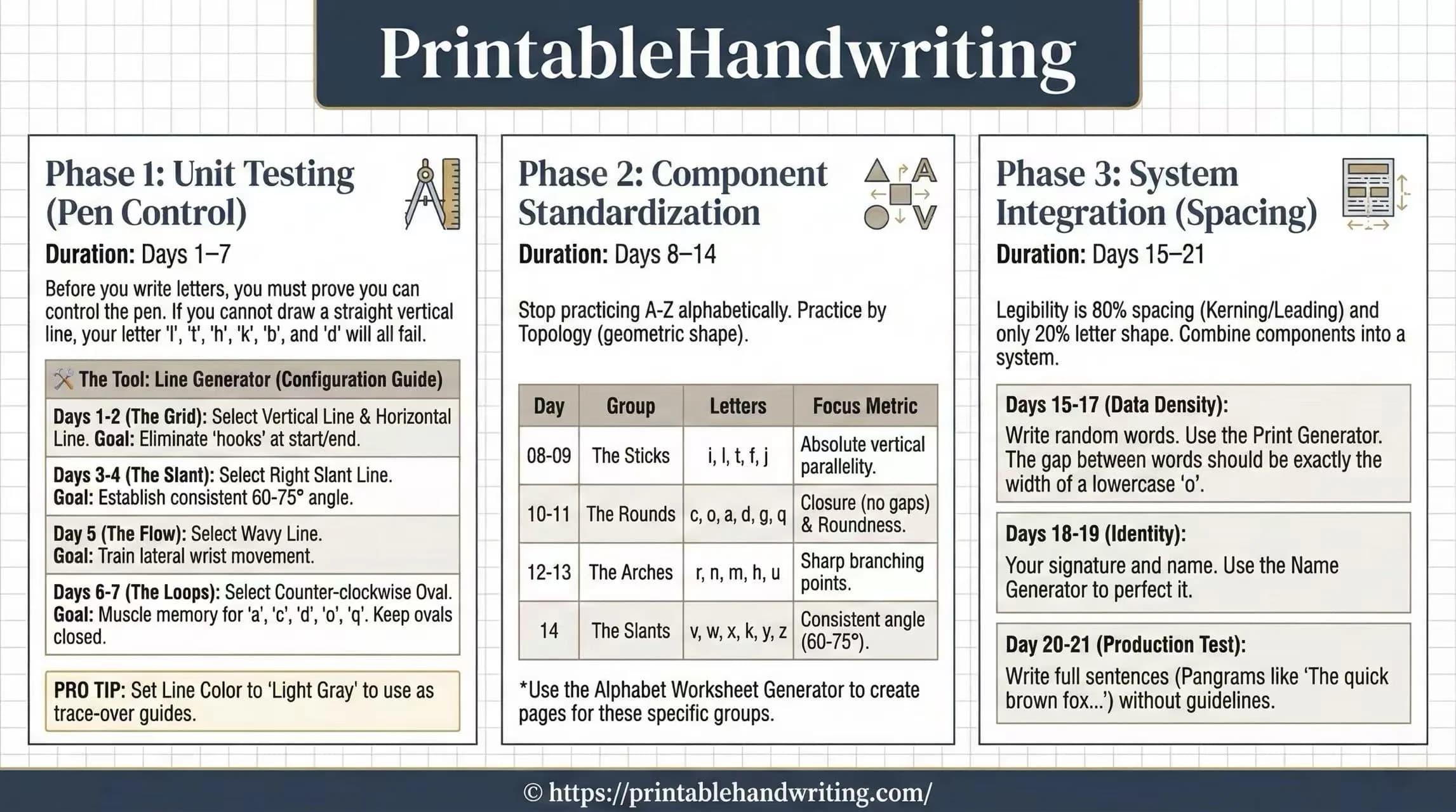
Save this image to your device and use it as your 21-day checklist.
How Does Phase 1 (Days 1-7) Build Pen Control?
Duration: Days 1-7
Before you write letters, you must prove you can control the pen. If you cannot draw a straight vertical line, your letter 'l', 't', 'h', 'k', 'b', and 'd' will all fail.
The Tool: Line Generator
Use the Line Worksheet Generator to create these specific patterns.
Configuration Guide
- Days 1-2 (The Grid): Select
Vertical LineandHorizontal Linefrom the menu.
Goal: Eliminate "hooks" at the start/end of your strokes. - Days 3-4 (The Slant): Select
Right Slant Line.
Goal: Establish a consistent 60-75° writing angle (crucial for italic print). - Day 5 (The Flow): Select
Wavy Line.
Goal: Train lateral wrist movement (moving across the page smoothly). - Days 6-7 (The Loops): Select
Counter-clockwise Oval.
Goal: This is the exact muscle memory for 'a', 'c', 'd', 'o', 'q'. Keep the ovals closed and even.
Why Practice Letters by Shape Instead of Alphabet?
Duration: Days 8-14
Stop practicing A-Z alphabetically. That is inefficient. Practice by Topology (geometric shape).
| Day | Group | Letters | Focus Metric |
|---|---|---|---|
| 08-09 | The Sticks | i, l, t, f, j | Absolute vertical parallelity. |
| 10-11 | The Rounds | c, o, a, d, g, q | Closure (no gaps) & Roundness. |
| 12-13 | The Arches | r, n, m, h, u | Sharp branching points. |
| 14 | The Slants | v, w, x, k, y, z | Consistent angle (60-75°). |
How Does Phase 3 (Days 15-21) Master Spacing?
Duration: Days 15-21
Legibility is 80% spacing (Kerning/Leading) and only 20% letter shape. Now we combine the components into a system.
- Days 15-17 (Data Density): Write random words. The gap between words should be exactly the width of a lowercase 'o'.
- Days 18-19 (Identity): Your signature and name. This is your most frequent "code snippet." Practice writing it repeatedly until it feels automatic.
- Day 20-21 (Production Test): Write full sentences (Pangrams like "The quick brown fox...") without guidelines.
Ready to start the 3-week schedule?
By the end of this challenge, you should have a clearer routine and better visibility into which drills help you most. If you still need more time, repeat the phase that addresses your weakest skill instead of assuming the whole plan failed.
If you haven't already, save the schedule image to your phone and set up the first worksheet before Day 1. That makes it much easier to follow through once the challenge starts.
Build your Day 1 worksheets
Start with line-control sheets for Phase 1, then move to letter and word practice in Phase 2 and Phase 3. Having the pages ready in advance makes the challenge much easier to complete.
Frequently asked questions
How long does it take to improve handwriting?
There is no universal magic number. A 21-day challenge is a simple, memorable way to organize three weeks of focused practice: pen control first, then letter groups, then sentence-level spacing and fluency.
Sources & References
Review found that handwriting interventions need actual handwriting practice, and very short or non-practice-based interventions were generally ineffective.
Summarizes school handwriting programs that often run for multiple weeks rather than relying on a fixed universal timeline.
Suggests task-specific motor practice is the important ingredient; device-only approaches did not show the same support in the reviewed studies.