Quick Answer
Why is my handwriting so bad?
Bad handwriting is rarely about talent — it's about inconsistent spacing, uneven letter heights, and broken visual rhythm. Your brain perceives text as 'messy' when baseline alignment, x-height ratio, and inter-letter spacing vary unpredictably, increasing cognitive load for the reader.
The most common misconception about handwriting is that to have "good" handwriting, every single letter must look like a calligraphy masterpiece. But why do we inherently look at one piece of paper and think "beautiful," and another and think "messy"?
If you want a practical, guided path instead of guesswork, use a structured evaluation to identify your top issues before choosing drills. A baseline check works best when you already know which dimension you want to verify.
Why Does Our Brain Interpret Some Handwriting as "Ugly"?
The human brain is an advanced pattern-recognition machine. When we look at text, we aren't just reading words; our visual cortex is subconsciously analyzing the geometry of the shapes.
What Causes the Cognitive Load of Broken Rhythms?
According to Gestalt Psychology, our brains prefer order, symmetry, and continuation. When text is written with consistent height, spacing, and slant, it creates a predictable visual rhythm. The brain can process this rhythm effortlessly.
"Ugly" or "messy" handwriting is simply Visual Noise. When letters vary wildly in size or bounce off the baseline, the reader's eye has to constantly micro-adjust its focus. This breaks the expected pattern and forces the brain to spend extra "GPU cycles" (processing power) just to identify the letter forms, rather than comprehending the meaning.
The Friction of Perception
In Human-Computer Interaction, Cognitive Load Theory dictates that interfaces must minimize unnecessary cognitive friction.
Your handwriting is an interface. When we subjectively feel that handwriting is "bad," what we are actually experiencing is the frustration of high cognitive friction. We interpret inefficiency as ugliness.
What Are the 4 Core "Bugs" That Make Handwriting Look Bad?
If "ugly" is just a lack of visual predictability, we can debug it by breaking down the geometry of handwriting into four distinct dimensions. Which of these bugs is running in your muscle memory?
| The Handwriting Bug | The Visual Symptom | UI/UX Equivalent |
|---|---|---|
| 1. Baseline Jitter (Y-Axis Tracking) | Words look like they are floating up or sinking down. The text cannot hold a straight horizontal line. | Vertical-Align Failure |
| 2. X-Height Collapse (Proportion) | Lowercase letters (a, e, o, m) are drastically different sizes. A tall 'a' next to a tiny 'e'. | Font Scaling Error |
| 3. Random Slant Variance (Angle) | One letter leans left (45°), the next leans right (110°), the next is strictly vertical (90°). | Transform: Skew() Chaos |
| 4. Irregular Kerning (Negative Space) | Letters are crammed together in one word, and drifting apart in the next. The white space is ignored. | Inconsistent Margin/Padding |
Why Is "Negative Space" the Secret to Legible Handwriting?
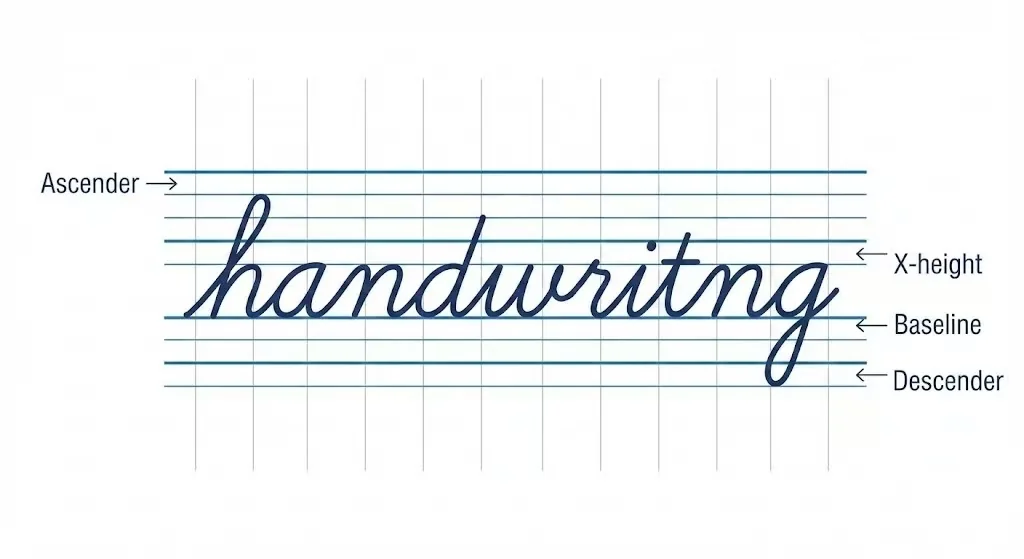
Most people only look at the ink (the positive space). But the human eye evaluates proportion based on the empty paper inside and around the letters (the negative space, or "counters" in typography). If the loop of your 'e' is crushed, or the space between 'h' and 'e' is too wide, the geometric balance is destroyed.
Why Does the Hand Fail to Execute What the Brain Intends?
If our brains know what a straight line looks like, why does the hand fail to draw it? This bridges the gap between intention and execution—the Fine Motor Skills bottleneck.
- Drawing from the Wrist, Not the Arm: Many people with messy handwriting "plant" their wrist on the table and only move their fingers. This creates a highly restricted radial arc. As you write across the page, your baseline naturally curves downward because your fingers run out of reach.(For a deeper dive, separate physiological fatigue from visible letter-structure errors.)
- Speed vs. Accuracy Trade-off: You are trying to run a program faster than your hardware allows. When you write quickly, your motor system cuts corners, turning sharp angles into sloppy curves and failing to close loops (e.g., an 'o' looking like a 'u').
How Do You Fix Messy Handwriting with a Structured Approach?
Now that you understand the root causes—geometric inconsistency and fine-motor failure—how do we fix it?Telling someone to "just write neater" is useless. You need a structural approach to retrain your neural pathways.
Phase 1: Regain Stroke Control (Stabilize)
Before you worry about writing words, you need to prove your hand can draw the shapes that make up words. Spend 5 minutes a day drawing deliberate straight vertical lines, horizontal lines, and perfect circles. Do not rush.
Phase 2: Standardize the X-Height
This is the highest ROI (Return on Investment) fix. Force every single lowercase letter (a, c, e, m, n, o, r, s, u, v, w, x, z) to be exactly the same height. Use paper with a mid-line (like French-ruled paper or primary school paper). Your only goal is to make sure the top of the letter touches the dashed line, and the bottom touches the baseline.
Phase 3: The Ghost Line Technique (Slant Consistency)
To fix random slanting, draw diagonal guidelines across your page at a fixed angle (e.g., 70 degrees) before you start writing. As you write, force the downstrokes of letters like 'l', 't', and 'h' to run parallel to these ghost lines.
How can you fix inconsistent handwriting spacing?
Inconsistent spacing means the gaps within or between words change enough to make the text harder to separate. Start by identifying which gap is unclear: letters crowded inside one word need a different check from two words running together. Aim for readable spacing in your writing style; equal millimetre gaps between every letter are not a universal rule.
| Spacing feature | What to look for | One practice focus |
|---|---|---|
| Letter spacing | In print, adjacent letters crowd, touch unintentionally, or spread apart within a word. | Copy a short word and compare the same letter pairs across repeats. |
| Word spacing | Two words look joined, or the gaps between words vary so much that boundaries become unclear. | Copy a short sentence while preserving a visible gap at each word boundary. |
Cursive letters can join intentionally. Check the gaps between words without forcing each connected letter apart; the print practice below is an option for adults working on separate letter forms.
Use one repeatable spacing check
- Write Clear word spaces help each short sentence stay easy to read. once at a comfortable pace. Keep the dated sample and note your paper, pen, and whether you copied a model.
- Check its ten word boundaries. Count how many look joined or ambiguous, and record the count out of ten. This is your own comparison measure, not a standardized score or a pass/fail threshold.
- For letter crowding, mark one repeated letter pair that is difficult to distinguish. For word spacing, focus on the unclear boundaries. Practise one of these features at a time instead of changing spacing, size, slant, and speed together.
- Copy the sentence, then write a fresh version without the model. Compare the same boundaries and letter pairs under the same conditions. If the result is less readable, return to a shorter sample or a more comfortable pace rather than filling a whole page with rushed repeats.
For ready-made adult print practice, use pages 5 and 6 of the Adult Print Legibility Foundations Pack: Letter Spacing Practice and Word Spacing Practice. Start with the page that matches your observation. The Pack also links to the Print generator if you need your own words; the generator helps create a model, while your independent sample checks whether the spacing carries over.
Keep the original sample alongside the next dated comparison. A clearer copied line alone does not prove that everyday writing has changed. This exercise describes visible spacing and cannot identify a medical condition or explain why a difficulty occurs.
Ready to Retrain the Core Patterns?
Once you know which bug is disrupting your writing most, move into focused worksheet practice and keep the drills narrow: baseline control, x-height consistency, or spacing.
Use the line generator or the adult print spacing pages linked above for the matching practice. Compare another independent sample before adding a different practice target.
Start with one weak dimension at a time so your practice does not turn back into vague repetition.
Conclusion: Beautiful handwriting isn't magic, and ugly handwriting isn't a permanent disease. It is simply physical control combined with geometric consistency. By understanding the visual psychology of pattern recognition and systematically practicing your baseline and x-height, anyone can refactor their handwriting system.
Frequently asked questions
Why is my handwriting so bad?
Bad handwriting is rarely about talent — it's about inconsistent spacing, uneven letter heights, and broken visual rhythm. Your brain perceives text as 'messy' when baseline alignment, x-height ratio, and inter-letter spacing vary unpredictably, increasing cognitive load for the reader.
How can I improve inconsistent handwriting spacing?
First separate crowded letters inside a word from unclear gaps between words. Copy the same short sentence at a comfortable pace, check whether each word boundary is visible, and change only the spacing feature you are practising. For adult print, pages 5 and 6 of the Adult Print Legibility Foundations Pack provide letter-spacing and word-spacing copy practice. Compare a fresh independent sample under the same conditions; this is a practice check, not a diagnostic score or a guarantee of improvement.
Sources & References
Explains extraneous cognitive load—the friction readers feel when visual patterns are inconsistent, matching this article’s “ugly = high processing cost” framing.
Reviews product features (spacing, alignment, size, formation) that drive perceived handwriting quality—the dimensions this page treats as “bugs.”
Summarizes handwriting competency factors and why inconsistent motor output (rhythm, sizing, baseline) undermines functional writing.
Foundational cognitive-load evidence that unnecessary processing demands compete with comprehension—applied here to visual decoding of messy text.