Pen-control line sample PDFs
Continuous Wave Pen-Control Practice - A4
A continuous-wave A4 pen-control sample for practicing direction changes, steady spacing, and smooth pressure before letter formation.
Practice objective
Practice continuous curves and direction changes with a steady rhythm before adding the complexity of letter shapes.
When this is not the right page: This is not a letter-formation or medical therapy plan. If your main issue is spacing or recognizable letters, choose a print or alphabet sample instead.
- Format
- A4 PDF
- Length
- 2 pages
- Best for
- Pre-writing learners and anyone rebuilding pen control
- Updated
- August 6, 2026
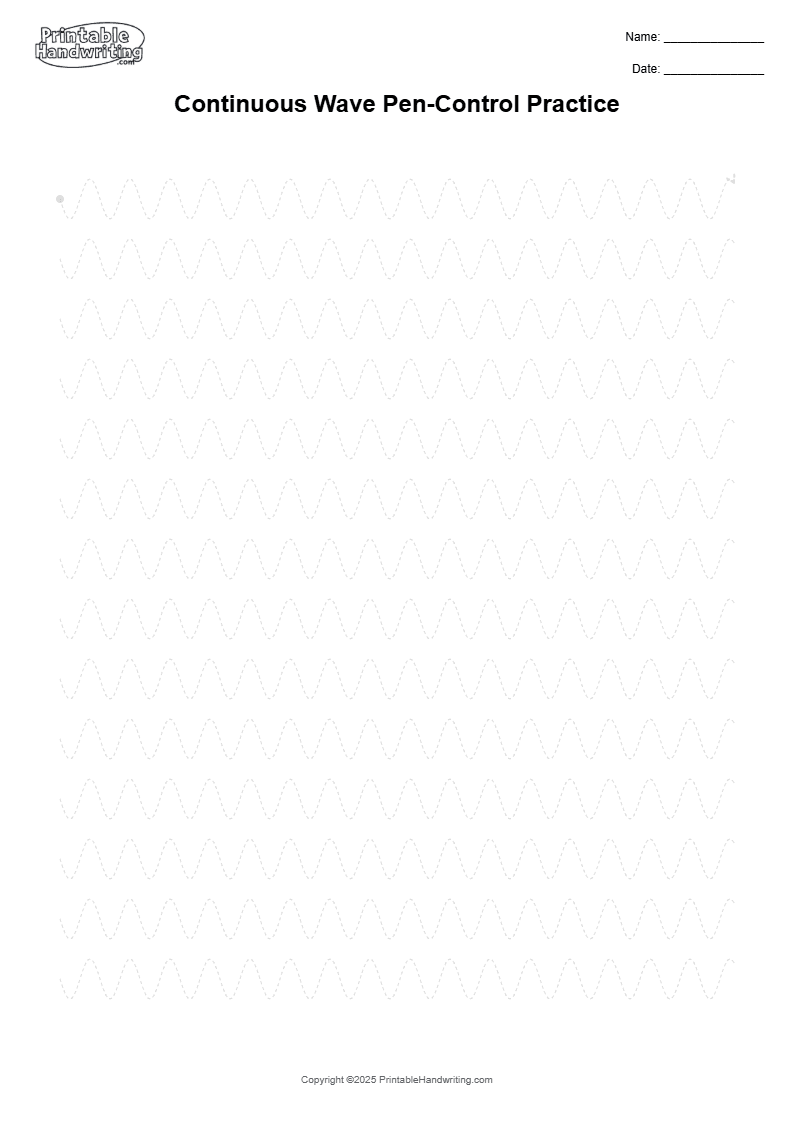
Preview of the downloadable worksheet
The sample PDF is public and does not require an account.
Who this sample is for
Use this sample before letter practice when pen control, pressure, or smooth direction changes are the current bottleneck. It can also help an adult return to writing after a long break, as a short warm-up rather than a diagnosis.
How to practice with this PDF
Follow the large model waves on page one with a relaxed grip. Move from shoulder and forearm rather than squeezing the fingers. On page two, follow the dotted guide at a comfortable pace and pause only at the page edge. Compare amplitude and smoothness, not speed.
Page reading guide
What this sample makes visible
The two pages keep the same continuous-wave movement while changing the amount of control the line asks for. Page one gives a broad path that makes direction changes easy to see. Page two asks for a slightly tighter rhythm. This contrast is useful because it shows whether the line stays smooth as the movement becomes smaller, without introducing a letter shape or a claim about diagnosis.
Look at the peaks and valleys before looking at the speed. A steady wave has a similar rise and fall, while a squeezed grip often produces sharp corners, shrinking peaks, or frequent lifts. If the movement becomes uneven only near the right edge, note where that happens. That is a better signal for the next practice round than trying to make every curve identical on the first attempt.
Choose the next drill from the visible movement. Broad waves that remain controlled can progress to a slightly tighter custom wave or a different direction. Waves that break into corners should stay broad with fewer rows. When the wave is smooth but letter starts still feel uncertain, move to the lowercase formation page rather than turning this warm-up into a substitute for letter instruction.
What to check after one practice round
Use these prompts after one calm pass. They turn a vague impression into an observation you can repeat.
- Does the wave keep a similar amplitude from left to right?
- Are direction changes smooth instead of sharp corners?
- Can you keep the line moving without frequent lifts?
- Does the second page stay controlled at a slightly tighter rhythm?
Common mistakes with this sample
- 01
Lifting the pen at every curve and losing the continuous rhythm.
- 02
Starting too quickly and shrinking the wave amplitude.
- 03
Jumping to tight zigzags before the broad curve is controlled.
Ready to practice?
Print at 100 percent on A4. Keep the model visible for the first pass, then use the self-check prompts above before making a new version.
This sample is generated on A4. When printing on US Letter paper, choose “Fit” or “Fit to printable area” in the print dialog. If the preview clips, do not use “Actual size.”
These sample PDFs are free for personal and classroom use. Redistribution as a paid pack is not allowed. For custom pages, use the on-site generators. See the Terms of Use.
Source note: The page was captured from the line-drill route with a wavy-line parameter and two generated practice pages. It contains no claims about treatment outcomes and no user-uploaded material.
Sample record maintained by Xin Wan. Published August 6, 2026; updated August 6, 2026.
Related practice samples
Keep the movement target consistent, or compare a nearby style.