Alphabet formation sample PDFs
Lowercase a-z Letter Formation - A4
A lowercase a-z A4 formation sample with grouped letters and repeated stroke cues before independent writing.
Practice objective
Build repeatable lowercase letter starts, x-height, ascenders, and descenders in small groups rather than rushing through the full alphabet.
When this is not the right page: This page is not a handwriting diagnosis and it is not a claim that a fixed number of letters suits every learner. Use shorter groups when fatigue or motor control is the limiting factor.
- Format
- A4 PDF
- Length
- 3 pages
- Best for
- Beginning letter-form learners
- Updated
- August 6, 2026
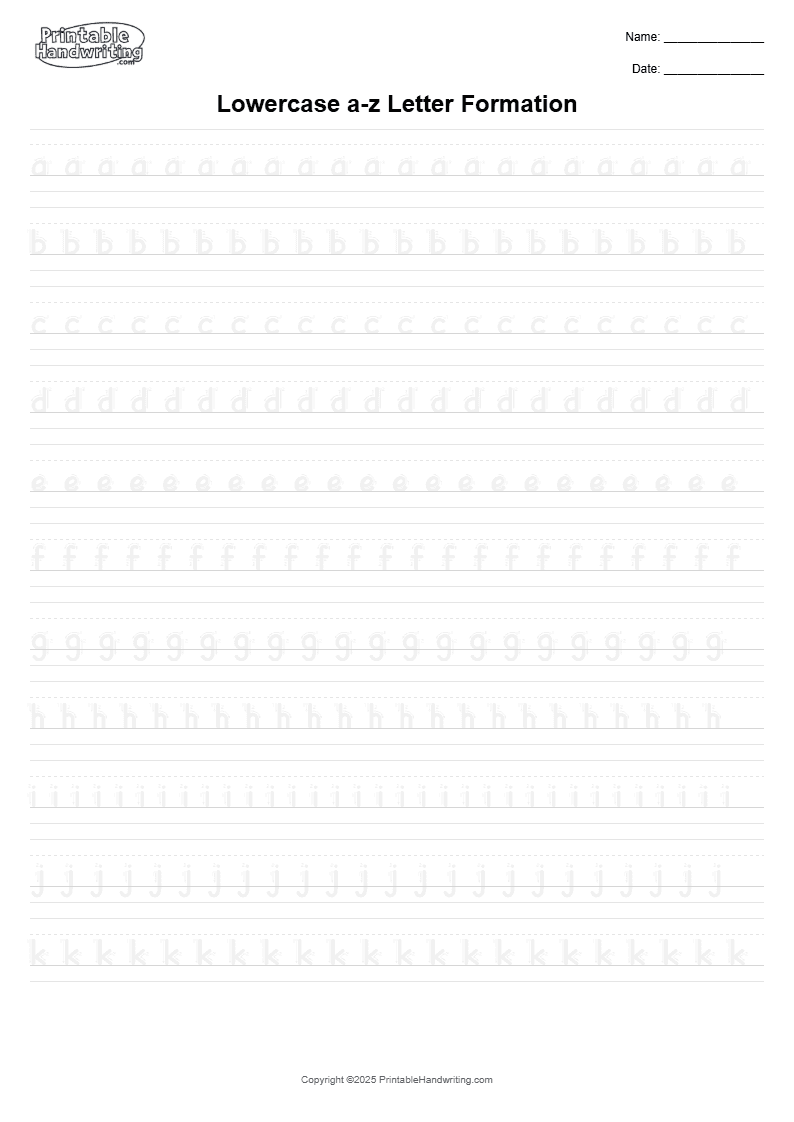
Preview of the downloadable worksheet
The sample PDF is public and does not require an account.
Who this sample is for
Use this sample when a learner recognizes letters but needs a clear formation sequence. Teachers can select one group for a lesson; adults relearning a consistent lowercase hand can use the same page at a larger grid.
How to practice with this PDF
Work in a small group of letters. Trace the model while saying the starting direction, then copy the group twice. Put a small check beside the row where the size and stroke start feel repeatable. Stop before fatigue turns every letter into a new shape; the next session can continue with the following group.
Page reading guide
What this sample makes visible
The three generated pages group lowercase letters by formation intent so the learner can study a smaller movement family instead of treating a-z as one uninterrupted task. A rounded letter, a tall ascender, and a descender ask for different control. The grouping is a practical sequence for this worksheet, not a claim that every learner must follow one universal alphabet order.
Use the first independent copy in each group to decide what to keep. A letter can look neat after tracing yet start in a different direction when the cue is removed. Notice whether the issue is the initial stroke, the height of the middle-zone letters, or the length of an ascender or descender. Naming that difference is more useful than completing all rows with the model visible.
End a session after one group remains consistent, even if other pages are still blank. A custom page can add rows for one starting stroke, change from lowercase to uppercase, or adjust the grid only after the target is clear. Move to a name sample when the challenge is applying known letters in a short word; move to pen-control lines when smooth curves are the limiting movement.
What to check after one practice round
Use these prompts after one calm pass. They turn a vague impression into an observation you can repeat.
- Does each letter start in the intended direction?
- Are x-height letters similar in size within a group?
- Do ascenders and descenders reach a consistent height?
- Can the learner write one group without tracing every row?
Common mistakes with this sample
- 01
Tracing every row without attempting an independent copy.
- 02
Ignoring the starting cue and focusing only on the final outline.
- 03
Trying to complete all 26 letters in one uninterrupted session.
Ready to practice?
Print at 100 percent on A4. Keep the model visible for the first pass, then use the self-check prompts above before making a new version.
This sample is generated on A4. When printing on US Letter paper, choose “Fit” or “Fit to printable area” in the print dialog. If the preview clips, do not use “Actual size.”
These sample PDFs are free for personal and classroom use. Redistribution as a paid pack is not allowed. For custom pages, use the on-site generators. See the Terms of Use.
Source note: The page uses the alphabet generator in lowercase mode and groups letters by formation intent across three generated pages. No child data or uploaded handwriting is used in this sample.
Sample record maintained by Xin Wan. Published August 6, 2026; updated August 6, 2026.
Related practice samples
Keep the movement target consistent, or compare a nearby style.