Italic sample PDFs
Italic Entry and Exit Joins - A4
An A4 italic sample that isolates entry and exit strokes so writers can compare a lighter join pattern with loop-heavy cursive.
Practice objective
Practice italic entry and exit strokes, moderate slant, and open counters without turning the page into conventional cursive.
When this is not the right page: Do not use this page when your goal is a full looped cursive alphabet or a decorative signature. Italic practice stays focused on readable, economical joins.
- Format
- A4 PDF
- Length
- 1 page
- Best for
- Older students and adults
- Updated
- August 6, 2026
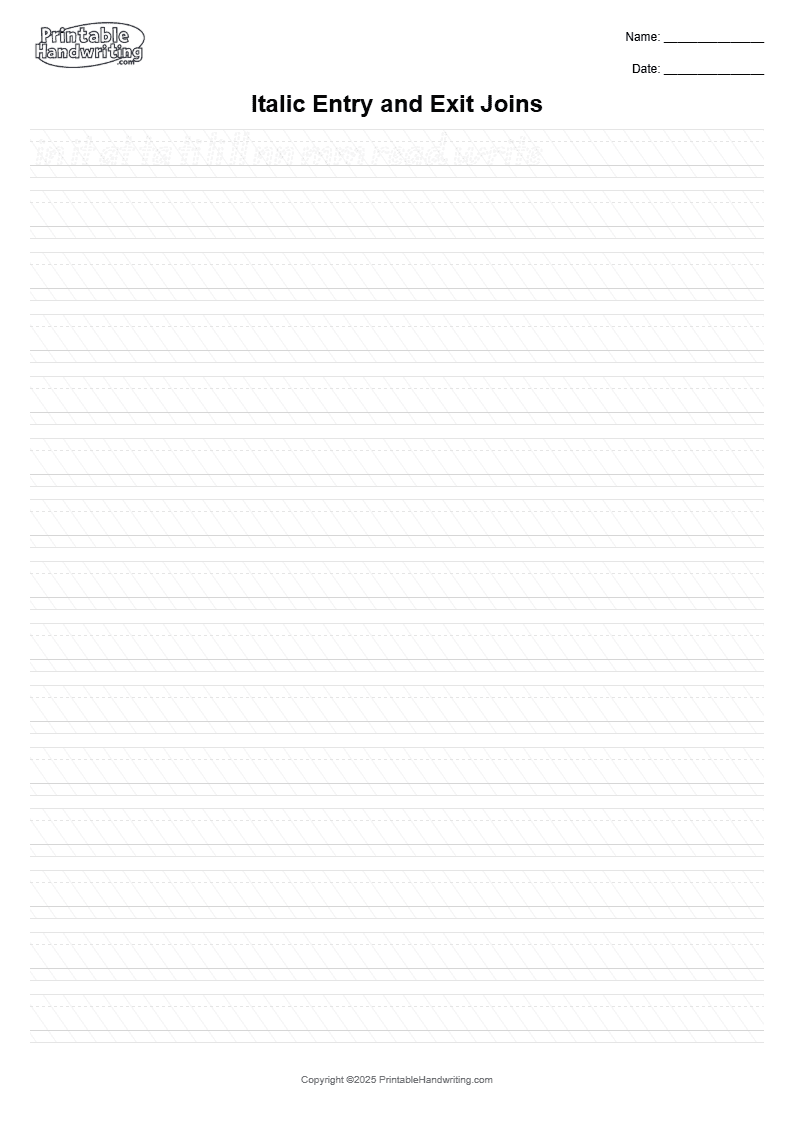
Preview of the downloadable worksheet
The sample PDF is public and does not require an account.
Who this sample is for
Choose this sample if you want a neat hybrid between separated print and fully looped cursive. It suits adult learners, older students, and teachers comparing writing styles for everyday notes.
How to practice with this PDF
Trace the entry strokes first, then the exit strokes. Copy each pair twice, keeping the pen moving through the join but lifting at word boundaries. Compare the first and last pair for slant drift and check whether the inside of a, e, and o remains open.
Page reading guide
What this sample makes visible
The short pairs on this page make the entry and exit strokes easier to isolate than a full cursive sentence. Compare the small lead-in before a letter with the stroke that leaves it: an economical italic join should guide the next letter without adding a large loop. The goal is a readable hand with a moderate slant, not a more ornate version of cursive.
Check the inside spaces of a, e, and o after each pair. When those counters begin to close, pause before changing the entire alphabet or changing pens. The problem may be one tight turn, an exit stroke that starts too early, or pressure that increases near the end of a line. Mark the exact pair where the counter closes so the next practice page can repeat the relevant movement.
Use the cursive alphabet sample only when the learning question is about looped connections across a broader letter set. Use the print spacing sample when the letter shapes are already open but the words crowd together. Keeping that distinction visible prevents this page from becoming a generic cursive worksheet and helps a custom italic page stay focused on one entry or exit pattern.
What to check after one practice round
Use these prompts after one calm pass. They turn a vague impression into an observation you can repeat.
- Does each entry stroke arrive at a consistent x-height?
- Does the exit stroke leave enough room for the next letter?
- Is the slant controlled rather than progressively leaning?
- Do counters stay open enough to preserve letter identity?
Common mistakes with this sample
- 01
Adding large loops that change the style into cursive.
- 02
Letting the slant increase across the line.
- 03
Closing counters because the pen moves too quickly through the turn.
Ready to practice?
Print at 100 percent on A4. Keep the model visible for the first pass, then use the self-check prompts above before making a new version.
This sample is generated on A4. When printing on US Letter paper, choose “Fit” or “Fit to printable area” in the print dialog. If the preview clips, do not use “Actual size.”
These sample PDFs are free for personal and classroom use. Redistribution as a paid pack is not allowed. For custom pages, use the on-site generators. See the Terms of Use.
Source note: The sample uses the italic generator path and an original short-pair text set. It is a single-page A4 artifact so the join target stays easy to compare across lines.
Sample record maintained by Xin Wan. Published August 6, 2026; updated August 6, 2026.
Related practice samples
Keep the movement target consistent, or compare a nearby style.