Quick Answer
How do you teach a child to write their name?
Choose a reason to use the name, such as signing a drawing. Invite the child to try their name, its first letter, or a mark that means their name. Write one example in front of them, then offer a little tracing or copying if it helps. When they want to try without a model, cover every example. Notice one letter together, and stop or return to more help when needed.
This is a short activity for a parent or teacher helping a child use their name. You need something to draw or write with, a picture to sign, and plain paper. A printed practice page and a spare sheet for covering examples are optional. The aim is one useful attempt, with the amount of help the child needs today.
1. Choose a useful name-writing moment
Start with a drawing the child wants to keep or give to someone. Ask, “Would you like to put your name on this picture?” A name now has a job: telling someone who made it. Maya is the fictional example used in this lesson; use the child’s own name when you try the activity.
Accept a mark, a first letter, or the name as their current attempt. You can ask what the mark says and write their name nearby if they want help. NAEYC’s emergent-writing guidance describes meaningful name-writing opportunities, including early first-letter and letter-like attempts. Head Start’s writing framework also includes drawings and scribbles used to convey meaning. These sources support a broader range of writing experiences than worksheets alone.
You do not need to turn this moment into an alphabet test or finish line-tracing pages first. If the child wants to keep drawing instead, let the drawing be the activity.
2. Choose the name or its first letter
For a printable page, open the free Name Worksheet Generator and choose Preschool name practice. Enter the name you want to use, then choose Whole name entered or First letter. The link opens the generator; it does not enter a name or choose a layout for you.
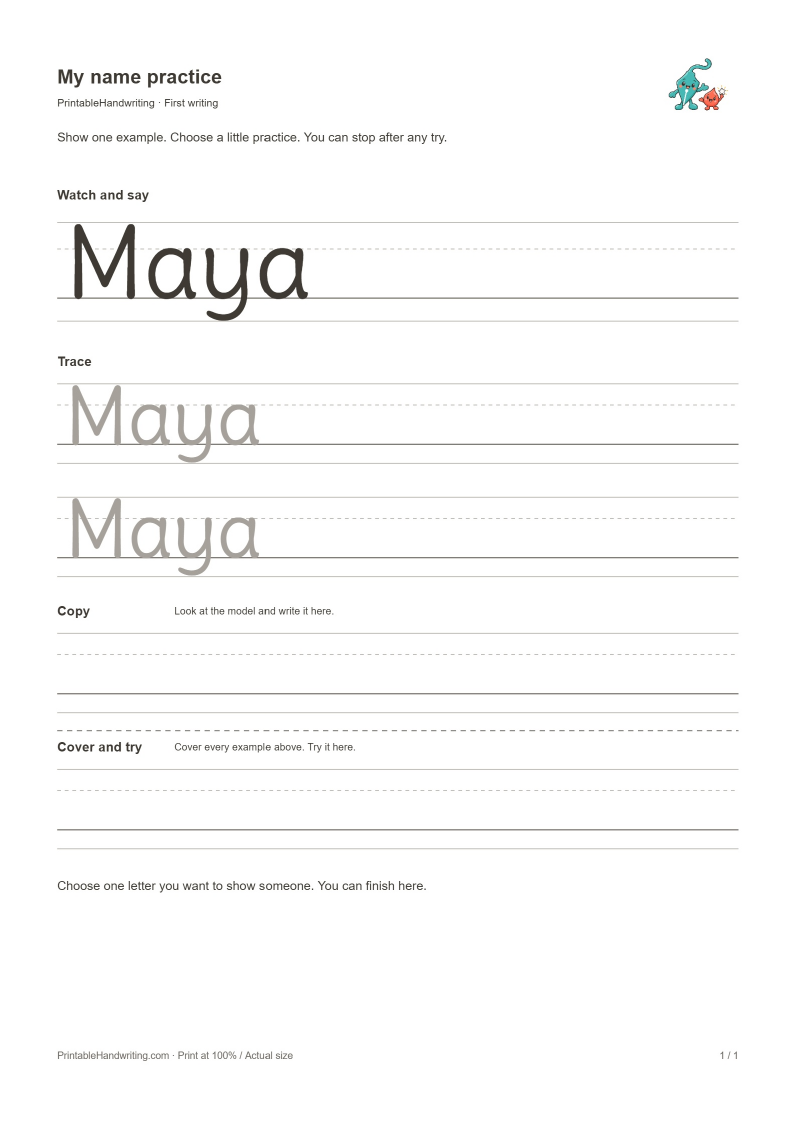
Below, “Maya” is the whole-name target and “M” is its first-letter target. The first-letter page keeps “My name: Maya” in the model area. For a longer name such as Liam Gallagher, the adult chooses whether to enter the first name or full name. The tool does not choose a nickname or remove the surname for you.
Whole name: Maya
First letter: M
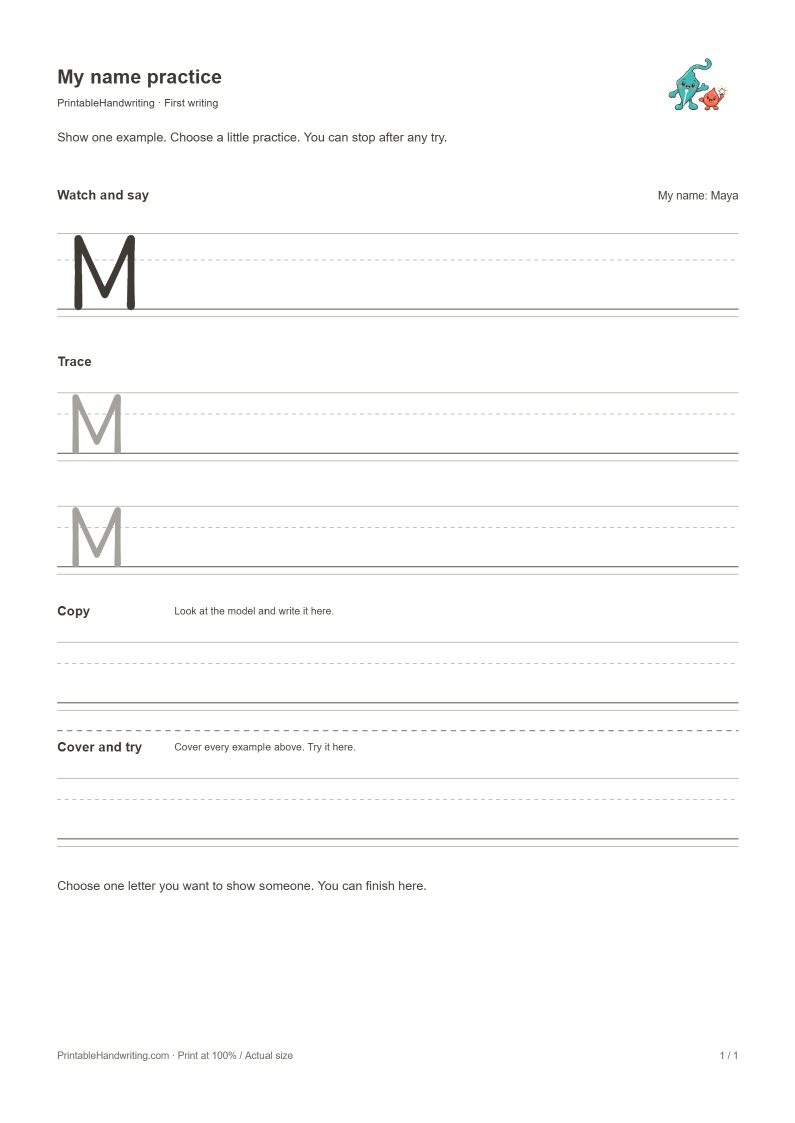
These are actual A4 portrait PDFs exported with Delius, Large · 16 mm, Trace + copy + try, and two tracing attempts. The count is an example recipe you can change, not a teaching requirement. Print the generated PDF on its selected paper at Actual size / 100%; these web images are previews.
3. Show one example and talk about it
Write the child’s name yourself where they can see the movement. For the Maya example, you could say, “I’m writing Maya so people know whose picture this is. Watch the tall M, then the smaller letters.” Point to the first letter and say the name together. If you are focusing on M, demonstrate that letter without requiring the rest of the name.
Use the spelling and capital letters the child actually uses. If school provides a model, compare its letter shapes before choosing a worksheet. This Delius page is a static print model for tracing and copying; it has no stroke-order arrows and is not a complete letter-formation lesson. The adult supplies the live demonstration.
For an example of showing a starting point, direction and pencil lift, see how to teach letter formation. That lesson follows an original lowercase a model; it does not supply stroke-order instructions for every Delius letter.
4. Trace, copy, or cover the models and try
Choose one section that helps with the current attempt. You can skip tracing, return to the visible model, or finish after one attempt. You do not have to work through the page from top to bottom.
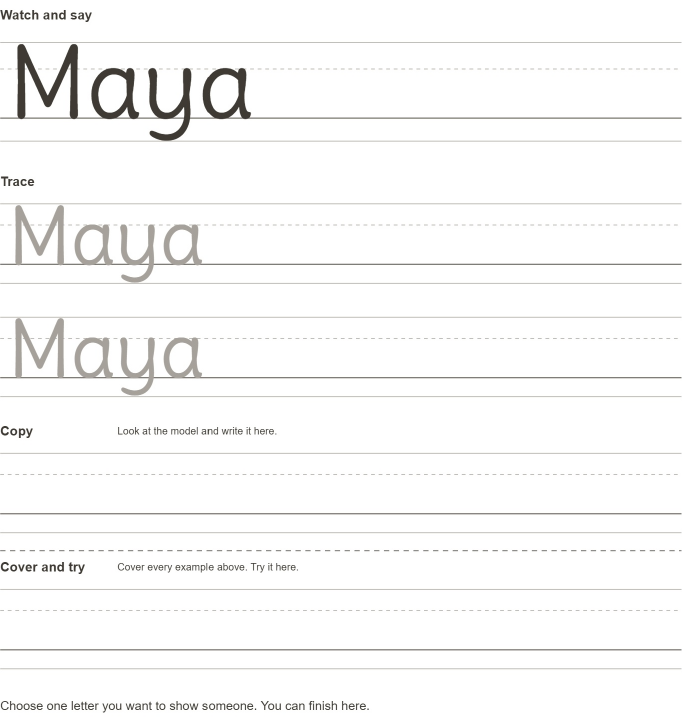
- Watch and say
- Look at the dark Maya model together while the adult shows an example.
- Trace
- The two light-gray Mayas are two optional tracing attempts. They are not blank copying rows.
- Copy
- Use the blank ruled row below “Copy” while looking back at the model.
- Cover and try
- Place spare paper over every printed name or letter above the dashed cover line, including both tracing attempts. Leave the blank row below “Cover and try” visible. Invite an attempt there without peeking at the model; uncover it afterward if the child wants to compare. If your page has continued onto another sheet, turn earlier pages face down too.
See the first-letter page in detail
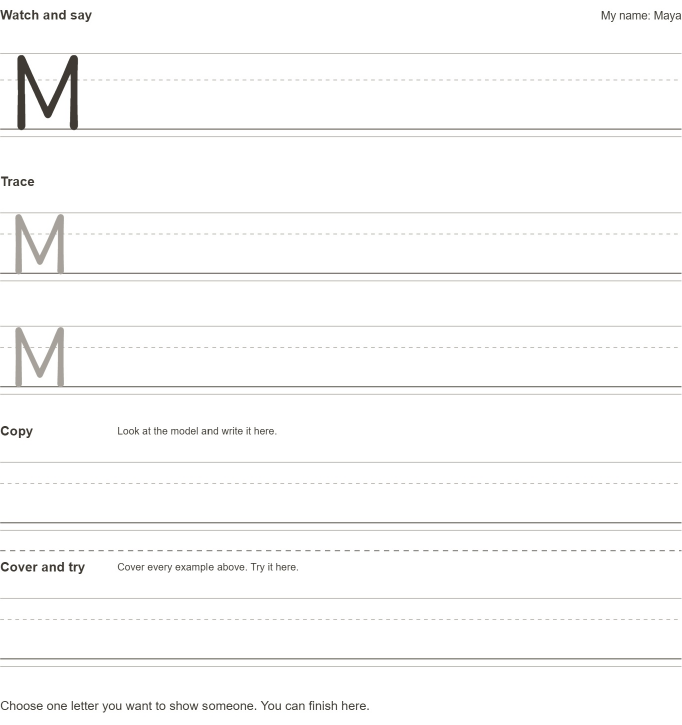
Practise M in the same sections. Before the covered attempt, hide the full-name reference as well as every printed M. Only the blank writing area stays visible.
For the general difference between the two kinds of support, see tracing versus copying. Here, the next step is chosen for this child and this attempt; more tracing is not an automatic answer.
5. Change the help when the task feels too big
- The name does not fit comfortably.
- Choose Wide or Medium and check every preview page. You can choose First letter, or decide yourself which name to enter. Do not squeeze the letters or let the tool change the spelling.
- Tracing works, but copying is difficult.
- Show one current letter again. Keep that model visible for a copy attempt, or return to tracing if the child chooses. Another full page is not required.
- The letters differ from the school model.
- Write the school’s example on plain paper, or preview a suitable font in Standard worksheet. The fixed Delius page does not adapt its letter shapes to a school scheme.
- The page cannot show a character in the name.
- Keep the name unchanged. Check an appropriate Standard worksheet font or write the model yourself; the preschool layout supports A–Z, spaces, hyphens and apostrophes.
- The child does not want to continue.
- Finish, return to drawing, or invite a mark on the picture if they want one. Leave unused rows empty. Reluctance during one activity is not a diagnosis.
6. Use one attempt and choose what comes next
Invite the child to put their name, first letter or chosen mark on the drawing. Ask, “Which letter would you like to show someone?” Let them point to one part of their attempt. The purpose is to use the name and notice something together, without giving a score or correcting every letter.
Next time, return to the same name, try its first letter with a visible model, or choose another meaningful writing moment. There is no daily page target or fixed number of weeks for mastering a name in this activity. If you want broader letter practice, the Alphabet Tracing Generator offers full A–Z worksheets. That is an optional different task, not a prerequisite for trying a name.
The sample page and these support choices are our activity design. The sources below inform meaningful writing and adult modeling; they do not establish this worksheet’s effectiveness or an ideal repetition count.
Frequently asked questions
Do we have to start with the whole name?
No. Invite a first letter or a mark that means the name if that is the child’s current attempt. In Preschool name practice, choose First letter to focus on the first letter of the entered name while keeping the name as a reference. You can return to the whole name another time.
What if tracing is easier than writing it alone?
Show one letter again in front of the child and offer a copy attempt with the model visible. They can also choose tracing or stop. When they want to try without help, cover every printed example first. An extra page of tracing is not a required next step.
Should I change the child's spelling or capital letters?
Keep the child’s actual spelling and capitalization. Compare the model with the one used at school. If the fixed Delius model or supported characters do not fit the name, use an appropriate model in Standard worksheet after checking its preview, or write the example yourself. Do not change a name just to fit the tool.
Must we finish every row?
No. The sections are choices, not a required sequence or a daily page target. Choose one useful attempt, use it to sign a picture if the child wants to, and finish there. You can return to the same name or its first letter on another occasion.
Sources & References
Meaningful name-writing opportunities, first-letter or letter-like attempts, and adults modeling writing. It does not evaluate this worksheet or its repetition count.
A broader writing framework that includes drawings, scribbles, letter-like forms and letters used to convey meaning. Its age bands are not a pass/fail test for this activity.