Print and manuscript sample PDFs
Print Letter-Spacing Drill - A4
An A4 spacing drill that keeps the vocabulary simple while isolating the difference between space inside a word and space between words.
Practice objective
Separate letter spacing from word spacing so the reader can follow the line without crowded joins or accidental gaps.
When this is not the right page: Do not use this page as a general adult handwriting course or as a substitute for letter-formation practice when the shapes themselves are the main issue.
- Format
- A4 PDF
- Length
- 1 page
- Best for
- Older students and adults
- Updated
- August 6, 2026
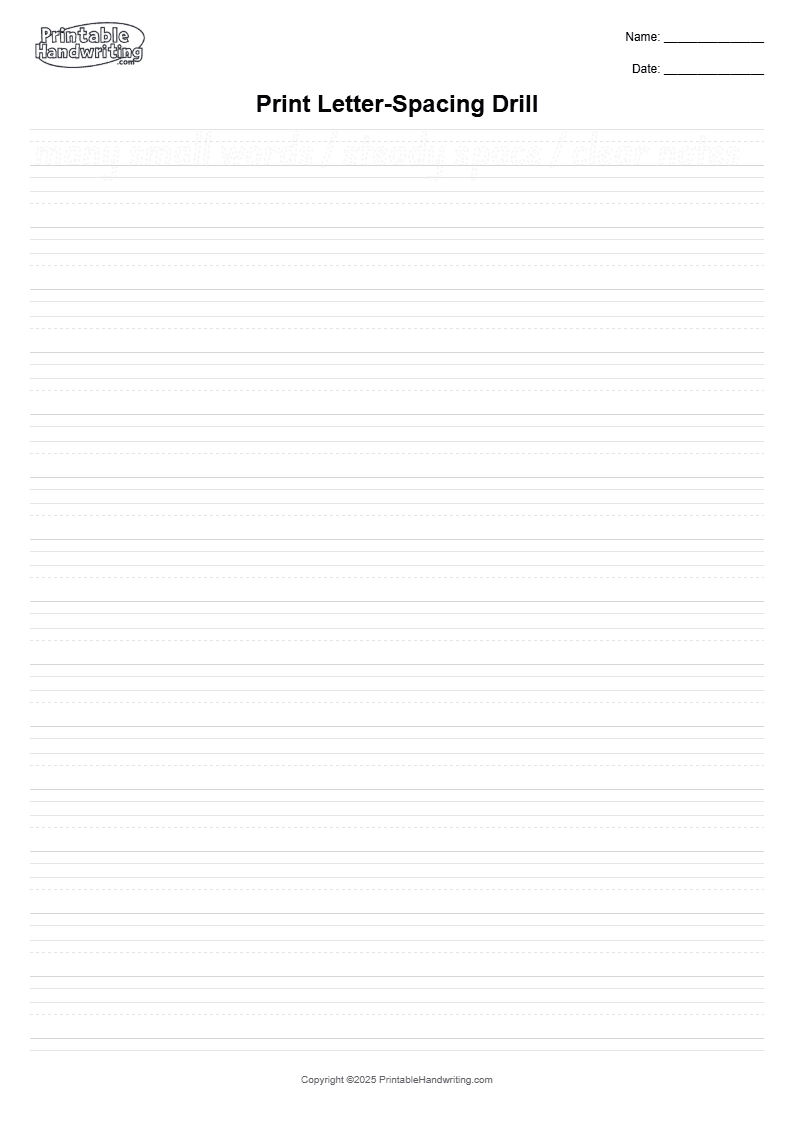
Preview of the downloadable worksheet
The sample PDF is public and does not require an account.
Who this sample is for
Choose this sample when readers can identify your letters but your notes look crowded, fragmented, or unevenly spaced. It is useful for adult note-taking, classroom copying, and anyone comparing two writing speeds.
How to practice with this PDF
Read the model line once, then copy it at a comfortable pace. Use the width of a lowercase o as a rough visual unit for the gap between words, while keeping letters within a word closer together. After each line, point to the widest and narrowest word gap and decide whether the difference is intentional.
Page reading guide
What this sample makes visible
This drill keeps the words short and uses slash marks only to separate the phrase groups in the model. The aim is not to imitate the slash; it is to make the white space between many, small, words, steady, space, clear, and notes easy to compare. Short words make crowded letter gaps and oversized word gaps visible before a longer sentence adds margin pressure.
After copying one line, cover the model and scan only the blank spaces. The gap inside many should be smaller than the blank area before small, and the final gap before notes should not collapse just because the line is almost complete. If a space changes after a particular letter pair, mark that pair rather than assuming every word needs a wider setting.
Use the result to choose one variable for a custom sheet. Writers whose internal letter gaps are the issue can repeat a small set of pairs such as n-a or m-a. Writers whose word gaps shrink at the margin can use a longer phrase on the same grid. Do not increase both the grid size and every gap at once; that makes it hard to tell which change improved readability.
What to check after one practice round
Use these prompts after one calm pass. They turn a vague impression into an observation you can repeat.
- Can you see a consistent small gap between letters in the same word?
- Is the word gap clearly wider than the letter gap?
- Do spaces remain stable when the line gets longer?
- Does the final word avoid crowding at the right margin?
Common mistakes with this sample
- 01
Making letter gaps and word gaps the same width.
- 02
Tightening every gap until letters touch when speed increases.
- 03
Practicing one short line only and never checking spacing at the line end.
Ready to practice?
Print at 100 percent on A4. Keep the model visible for the first pass, then use the self-check prompts above before making a new version.
This sample is generated on A4. When printing on US Letter paper, choose “Fit” or “Fit to printable area” in the print dialog. If the preview clips, do not use “Actual size.”
These sample PDFs are free for personal and classroom use. Redistribution as a paid pack is not allowed. For custom pages, use the on-site generators. See the Terms of Use.
Source note: The phrase set is original to this sample and was selected to repeat common spacing patterns without importing a published passage. The PDF was captured in A4 portrait format from the live worksheet generator page.
Sample record maintained by Xin Wan. Published August 6, 2026; updated August 6, 2026.
Related practice samples
Keep the movement target consistent, or compare a nearby style.