Print and manuscript sample PDFs
Adult Print Pangram Practice - A4
A ready-made A4 print practice page that repeats one pangram so adults can compare letter height, baseline control, and word spacing without changing the text between attempts.
Practice objective
Use the same pangram to observe print letter height, baseline stability, repeated-letter consistency, and the space between words.
When this is not the right page: This is not a first-letter formation lesson. If individual letters are still unfamiliar, start with the alphabet generator before comparing a full sentence.
- Format
- A4 PDF
- Length
- 1 page
- Best for
- Adults and older students
- Updated
- August 6, 2026
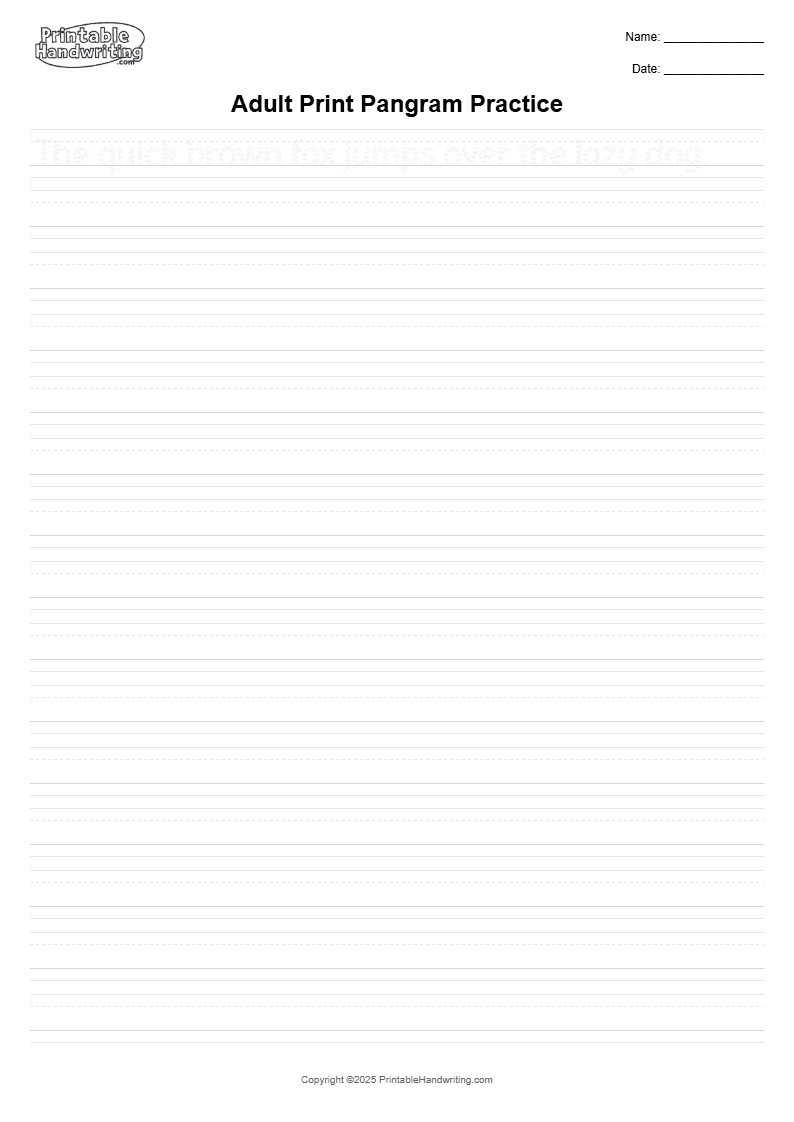
Preview of the downloadable worksheet
The sample PDF is public and does not require an account.
Who this sample is for
Use this sample when your everyday print writing is readable but drifts in size or spacing under normal speed. It suits adult learners, older students, and teachers who want a neutral diagnostic page for a short practice session.
How to practice with this PDF
Print one copy at 100 percent on A4. Trace the first two lines slowly, then copy the pangram on the final lines without tracing. Circle one place where the baseline, letter height, or spacing changes. Repeat on a fresh page after a break and compare the marked areas rather than judging the whole page at once.
Page reading guide
What this sample makes visible
A pangram puts every letter of the alphabet into one short, repeatable sentence. That makes this page useful for comparison: the words do not change between attempts, so a change in height, baseline, or spacing is more likely to come from the writing rather than from unfamiliar vocabulary. It is a practice observation, not a handwriting score.
Look first at the repeated rounded letters in quick, brown, fox, over, and dog. If those shapes grow or flatten as the sentence continues, make a note beside that point instead of correcting every letter immediately. Then compare the word gaps around the same repeated word positions on a second pass. A single marked pattern gives the next practice round a concrete target.
Choose the next page from the reason the line changed. A stable baseline with uneven gaps points toward the spacing drill; stable spacing with inconsistent o, e, or g shapes points toward a shorter custom phrase. Keep the same pencil, paper orientation, and grid for one comparison session so a useful observation is not hidden by several setting changes at once.
What to check after one practice round
Use these prompts after one calm pass. They turn a vague impression into an observation you can repeat.
- Does the baseline stay level from the first word to the last?
- Are tall and short letters kept at a repeatable height?
- Is the space inside a word visibly smaller than the space between words?
- Do repeated letters such as o, e, and g keep a similar shape?
Common mistakes with this sample
- 01
Chasing speed before the letter shapes are repeatable.
- 02
Compressing the final words to force the sentence onto one line.
- 03
Checking isolated letters while ignoring the rhythm of word spacing.
Ready to practice?
Print at 100 percent on A4. Keep the model visible for the first pass, then use the self-check prompts above before making a new version.
This sample is generated on A4. When printing on US Letter paper, choose “Fit” or “Fit to printable area” in the print dialog. If the preview clips, do not use “Actual size.”
These sample PDFs are free for personal and classroom use. Redistribution as a paid pack is not allowed. For custom pages, use the on-site generators. See the Terms of Use.
Source note: This PDF was captured from the print worksheet generator page using the parameters shown above. The page is intentionally a practice artifact, not a stock illustration or a user-uploaded sample.
Sample record maintained by Xin Wan. Published August 6, 2026; updated August 6, 2026.
Related practice samples
Keep the movement target consistent, or compare a nearby style.