Cursive sample PDFs
Cursive Sentence-Flow Practice - A4
A one-page A4 cursive sample for moving from individual joins into readable words and sentence rhythm.
Practice objective
Move from stable joins to word spacing, baseline control, and readable sentence flow without forcing speed.
When this is not the right page: Skip this sample if basic joins are still inconsistent. Return to a connected alphabet page before asking a whole sentence to flow.
- Format
- A4 PDF
- Length
- 1 page
- Best for
- Intermediate cursive learners
- Updated
- August 6, 2026
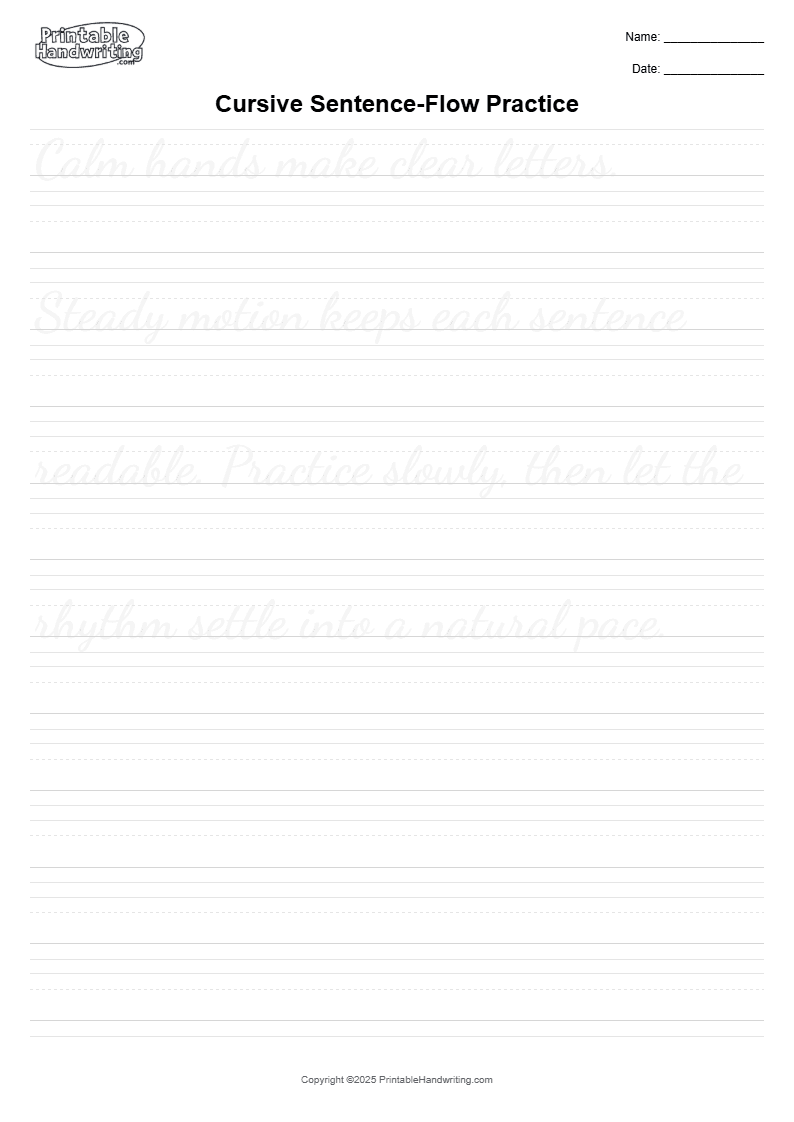
Preview of the downloadable worksheet
The sample PDF is public and does not require an account.
Who this sample is for
This is for writers who can form common cursive letters and want to practice a whole line with readable rhythm. It works for adult journaling, classroom copying, and short daily practice where legibility matters as much as speed.
How to practice with this PDF
Read the sentence before writing. Copy the first line slowly and mark where you naturally pause. Copy the next line at an ordinary pace, then compare the two for word separation and baseline drift. Use a custom page without the model visible if you want to test whether the flow transfers to independent writing.
Page reading guide
What this sample makes visible
The sentences use ordinary, short words so the page can reveal whether rhythm survives once letters become words. The model is a reference for the first pass, not a line to trace forever. A readable second copy with similar word gaps is more useful than a fast first copy that relies on looking back at every letter.
Compare the slow and ordinary-pace lines by looking at three places: the space after a word, the middle of a joined word, and the final third of the line. If the slow line is clear but the ordinary line loses only the word gaps, the next exercise should protect spacing. If joins fail in both lines, return to a smaller connected group before asking the hand to manage a full sentence.
Use a custom sentence only after you can say what this sample exposed. Replacing the text with a journal phrase or class sentence is useful when vocabulary matters, but changing text, font, and line height together removes the comparison point. Keep this large grid when testing flow; reduce it later only if the existing movement stays comfortably legible.
What to check after one practice round
Use these prompts after one calm pass. They turn a vague impression into an observation you can repeat.
- Do words remain separated while joins stay connected?
- Does the baseline stay steady through the middle of the sentence?
- Can a reader identify the sentence without relying on the model line?
- Do pauses occur at natural word boundaries rather than between letters?
Common mistakes with this sample
- 01
Removing word spaces to chase a faster line.
- 02
Stopping at every letter and losing the continuous stroke rhythm.
- 03
Compressing the final words when the line approaches the margin.
Ready to practice?
Print at 100 percent on A4. Keep the model visible for the first pass, then use the self-check prompts above before making a new version.
This sample is generated on A4. When printing on US Letter paper, choose “Fit” or “Fit to printable area” in the print dialog. If the preview clips, do not use “Actual size.”
These sample PDFs are free for personal and classroom use. Redistribution as a paid pack is not allowed. For custom pages, use the on-site generators. See the Terms of Use.
Source note: The sentences were written for this sample and do not reproduce a published passage. The one-page PDF was captured from the cursive generator with copy mode and the recorded large grid.
Sample record maintained by Xin Wan. Published August 6, 2026; updated August 6, 2026.
Related practice samples
Keep the movement target consistent, or compare a nearby style.