Cursive sample PDFs
Connected Cursive Alphabet Practice - A4
A connected cursive A-Z sample that focuses on entry and exit strokes, join height, and repeatable letter groups on an A4 practice page.
Practice objective
Observe how entry and exit strokes connect a cursive letter group without treating every letter as an isolated drawing.
When this is not the right page: This sample is not a claim that every learner must master print first. It is also not a sentence-flow page for writers who already have stable joins.
- Format
- A4 PDF
- Length
- 1 page
- Best for
- Learners with basic letter familiarity
- Updated
- August 6, 2026
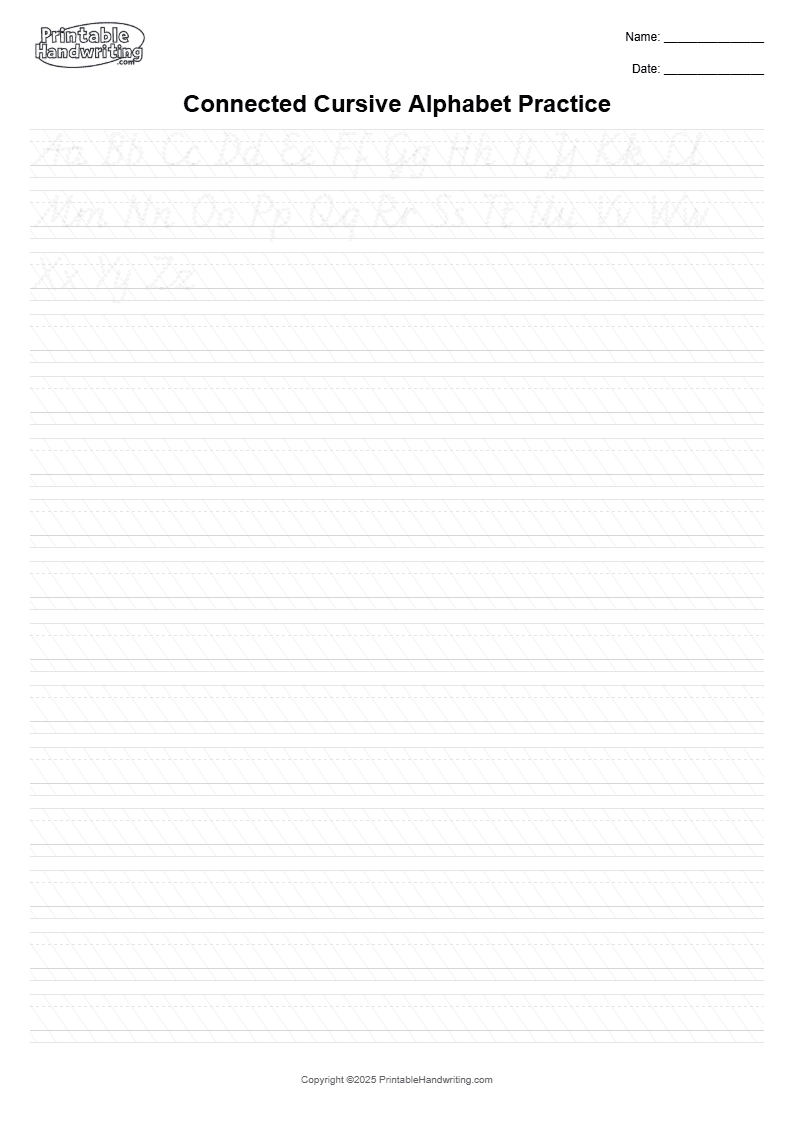
Preview of the downloadable worksheet
The sample PDF is public and does not require an account.
Who this sample is for
Use this sample when you know the basic alphabet but need a clear, low-pressure way to study connected strokes. Teachers can model one group at a time; adult learners can use the repeated groups to compare join stability.
How to practice with this PDF
Start with one letter group at a time. Trace a group, lift the pen, and name the point where the next letter begins. Then copy the same group twice without tracing. Leave a small mark beside any join that breaks so the next custom page can repeat it.
Page reading guide
What this sample makes visible
The alphabet is arranged as connected groups so the page can show where one stroke finishes and the next begins. It is more useful to compare a small run such as m-n-o than to race through A-Z. A join that is readable and repeatable at a relaxed pace is stronger evidence than a decorative loop that only appears once on the page.
Watch the height of the connection rather than the outer shape alone. A join that starts too high can pull the next letter upward; one that starts too low can flatten the following loop. Use the slant guide as a reference line, not a rule to force. Mark one pair that remains comfortable and one pair that breaks, then compare their exit strokes before adding more repetitions.
When a specific pair is the weak point, make a custom page with that pair in several short words. When the joins are stable but word separation disappears, move to the sentence-flow sample instead. This distinction keeps the alphabet page focused on connections and keeps a sentence page from disguising a basic join problem with more text.
What to check after one practice round
Use these prompts after one calm pass. They turn a vague impression into an observation you can repeat.
- Do joins continue at a similar height across a letter group?
- Does the slant stay within a comfortable range instead of leaning sharply?
- Are loops open enough for the letters to remain readable?
- Can you repeat a group without adding a stop between every letter?
Common mistakes with this sample
- 01
Treating each cursive letter as an isolated print shape.
- 02
Adding a large loop or dramatic slant to make the sample look decorative.
- 03
Changing join height from one pair to the next.
Ready to practice?
Print at 100 percent on A4. Keep the model visible for the first pass, then use the self-check prompts above before making a new version.
This sample is generated on A4. When printing on US Letter paper, choose “Fit” or “Fit to printable area” in the print dialog. If the preview clips, do not use “Actual size.”
These sample PDFs are free for personal and classroom use. Redistribution as a paid pack is not allowed. For custom pages, use the on-site generators. See the Terms of Use.
Source note: The alphabet grouping and slant-guide settings are recorded from the cursive generator. This one-page export keeps the model groups together so a learner can compare joins without changing the font or layout.
Sample record maintained by Xin Wan. Published August 6, 2026; updated August 6, 2026.
Related practice samples
Keep the movement target consistent, or compare a nearby style.