Quick Answer
Why does handwriting deform when you write faster?
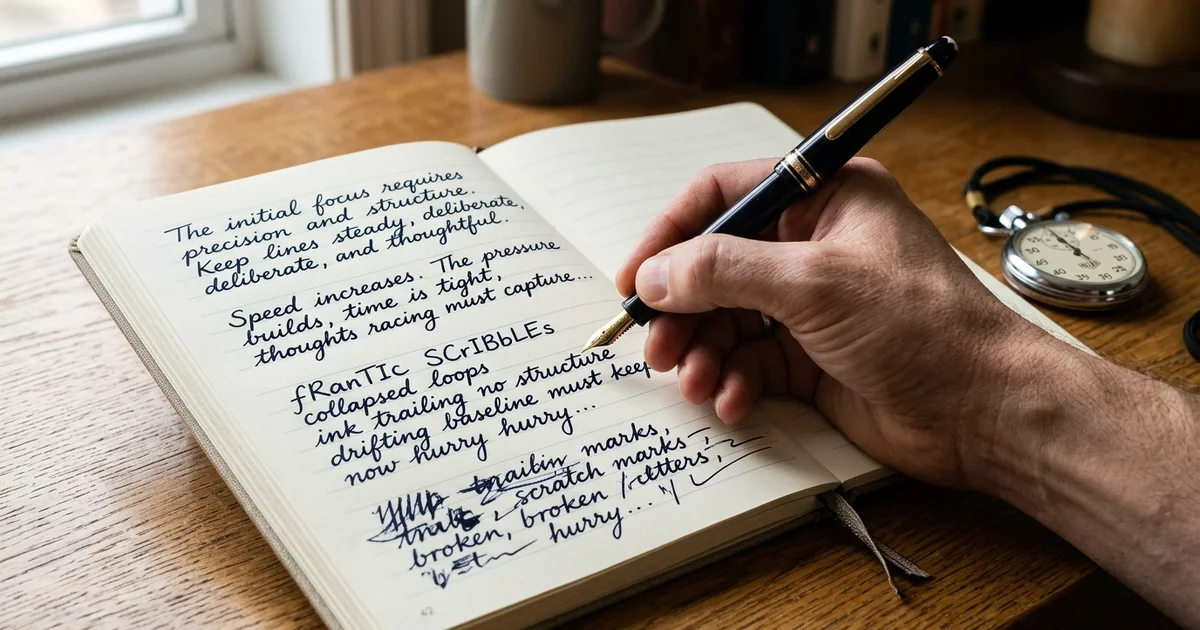
Writing at higher velocity forces the neuromuscular system to compress the deceleration and redirection phases of pen movement. To maintain tempo under Fitts's Law, the brain cuts braking times, causing sharp corners to round off (e.g., 'r' and 'n' become 'u'-like waves), interior loops to clog ('e' and 'a' fill in), and vertical ascenders/descenders to shorten. Static ink on paper hides these dynamics, making kinematic capture tools essential for analyzing real writing breakdown.
Almost every writer has experienced the sudden collapse of penmanship under time pressure. During an exam, an urgent phone message, or rapid minutes-taking, carefully practiced letterforms disintegrate into hurried, cryptic scrawls.
It is tempting to dismiss this degradation as simple carelessness or sloppy habits. Yet decades of motor learning and biomechanics research demonstrate that handwriting deformation is not an ethical failure of effort. It is a predictable physical consequence of how the human nervous system executes aimed movements under compressed time constraints.
When you push your pen past a specific tempo, your motor cortex reorganizes muscle firing sequences to prioritize continuous velocity over geometric precision. Understanding why and how this deformation happens is the first step toward stabilizing your writing at practical speeds.
The Biomechanics of Speed: What Physically Happens in Your Hand?
To understand why a letter collapses, you must first look at how a neat letter is drawn. Producing legible alphabetic text requires hundreds of micro-adjustments per second across your fingers, thumb, and wrist.
1. The Loss of the Neuromuscular Braking Phase
According to Réjean Plamondon’s Kinematic Theory of rapid human movements (the Delta-Lognormal model), every aimed pen stroke is produced by a synchronized duel between two opposing muscle systems:
- Agonist muscles: Accelerate the pen toward a target direction (e.g., pulling down to form the stem of a letter).
- Antagonist muscles: Fire in reverse to brake the pen tip, arrest momentum, and negotiate a sharp directional corner.
Under deliberate speeds, this braking phase ensures that the pen pauses momentarily (often for just 20 to 50 milliseconds) at vertices and baseline turnarounds. But when you accelerate, the nervous system simply runs out of processing window to fire antagonist braking pulses.
The result? The braking phase is cut entirely. The pen tip slings through turns without decelerating, transforming crisp angles into parabolic curves.
2. Fitts's Law and Target Precision
In 1954, psychologist Paul Fitts quantified the universal trade-off between movement duration and target accuracy. When applied to handwriting, every guideline boundary (the baseline, the midline, the descender line) and every letter loop acts as an aimed target.
Fitts's Law predicts that as movement duration decreases, the error variance around the spatial target expands exponentially. A writer attempting to double their character output per minute inevitably expands their stroke placement tolerance. When that tolerance exceeds the structural margins of the alphabet, letters mutate into ambiguous shapes.
Key Motor Control Insight
Speed degradation is not linear. Most writers maintain high legibility across modest tempo increases, until reaching a personal critical velocity threshold. Beyond this threshold, handwriting transitions abruptly from target-directed feedback control to open-loop ballistic movement, causing simultaneous collapse across multiple letter categories.
The 4 Classic Patterns of Speed Deformation
While handwriting styles vary widely, rapid deterioration follows identifiable geometric failure patterns. Across extensive clinical and educational studies, handwriting deformation concentrates in four primary dimensions:
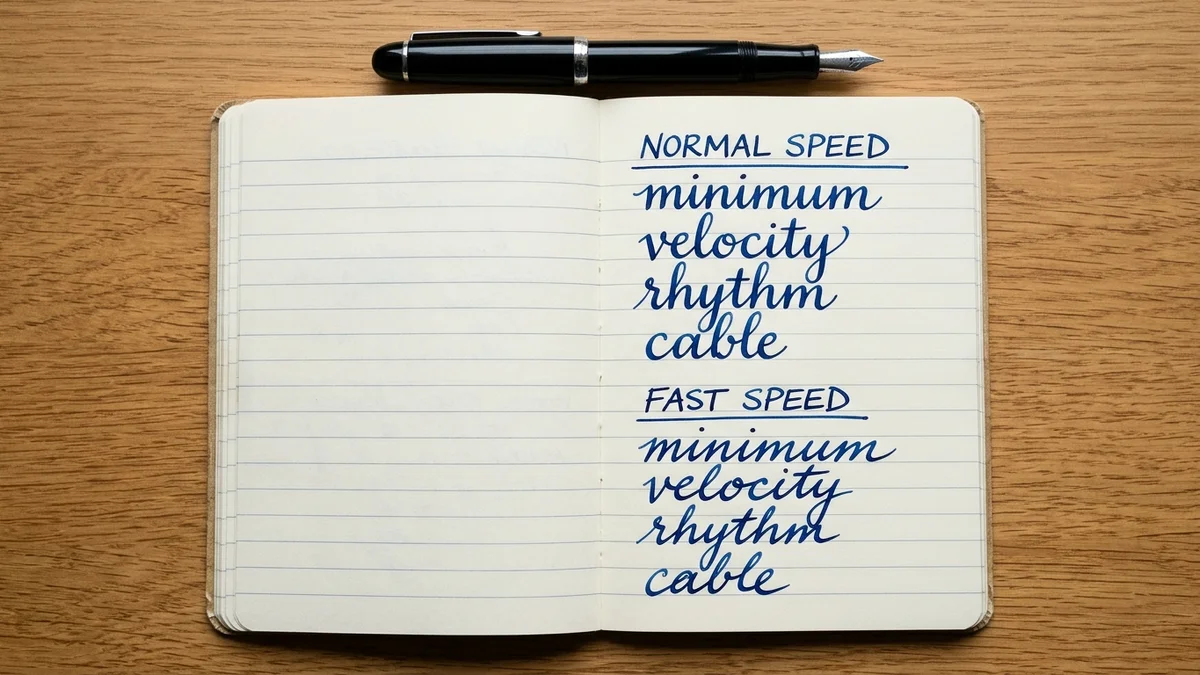
AVertex Rounding and Loop Collapse
As braking impulses disappear, direction reversals curve outward. Letters that depend on sharp inflection points (r, n, m, v, w) degenerate into indistinct sine waves, creating severe homoglyph ambiguities (e.g., "clear" reading as "dear", or "minimum" becoming a continuous sawtooth).
Concurrently, internal negative spaces (counter-loops in e, a, o) implode. Because executing an open loop requires an expansive outward curve before closing back to the stem, rushed writers shorten the excursion radius, filling the loop with ink or turning an "e" into an undifferentiated vertical stroke.
BAscender and Descender Truncation
Forming full-height ascenders (b, d, h, k, l) and descending tails (g, j, p, q, y) requires larger vertical excursions governed by wrist and forearm muscles.
To conserve time, writers unconsciously contract vertical travel. Ascenders shrink down toward the x-height (turning "cl" into "d", or "h" into "n"), while descender loops curl prematurely along the baseline. The visual contrast between tall, short, and deep characters is flattened.
CSpacing Decay and Inadvertent Ligatures
In handwriting kinematics, air-travel time—the time spent lifting the pen and moving to the next stroke—often accounts for 30% to 45% of total task duration.
When writers push for maximum output, the pen fails to clear the paper surface during transitions. The result is unwanted "drag marks" (inadvertent ligatures) bridging unjoined letters or adjacent words. Inter-word gaps compress, eliminating the whitespace cues that human eyes and OCR models rely upon to parse lexical boundaries.
DSlant Instability and Baseline Drift
Maintaining a uniform slant requires smooth coordination of finger extension and forearm progression across the page.
Under extreme haste, writers alternate erratically between forward slinging (exaggerated rightward slant) and awkward catch-up adjustments (vertical or backward-tilting stems). Without visual recalibration, the text drifts above or below the baseline, giving rapid text its characteristic undulating, chaotic rhythm.
Simulating vs. Measuring: Why Static Paper Isn't Enough
How should researchers and educators study this breakdown? Historically, handwriting evaluation relied almost entirely on post-hoc static analysis: examining ink marks on a sheet of paper long after the writer had finished.
As noted by Dr. Sara Rosenblum and colleagues in their landmark research on handwriting assessment, static product checks hide the most crucial diagnostic information:
- Velocity profiles: You cannot tell where the writer accelerated or hesitated from ink alone.
- Air-time vs. contact-time: A messy word might have taken 4 seconds of struggling or 0.8 seconds of careless dragging.
- Pacing hysteresis: Does a writer recover their neat baseline immediately after a speed burst, or does fatigue cause persistent residual deformation?
Furthermore, theoretical computer simulations of handwriting degradation—while valuable for algorithm testing—are inherently simplified. Algorithms typically assume uniform smoothing filters or mathematical spline distortions. Human writers, however, invent idiosyncratic physical workarounds: shifting grip pressure, reorienting paper mid-sentence, or inventing impromptu joins.
To truly understand how human handwriting degrades with tempo, we need direct empirical measurement of real writers writing at progressively controlled speeds.
A Real-World Research Tool: Kate Gladstone's HQL Project

Kate Gladstone
Handwriting SpecialistDirector of the World Handwriting Contest; author of Read Cursive Fast; CEO of Handwriting Repair / Handwriting That Works (Albany, NY).
For decades, Kate has investigated handwriting mechanics, legibility barriers, and model design across educational and clinical settings.
To bridge the gap between theoretical models and real-world handwriting dynamics, Kate Gladstone is developing HQL—an iPad research app specifically engineered to capture and examine how handwriting changes with speed.
The HQL iPad Investigation
Rather than analyzing isolated handwriting samples or relying on synthetic simulations, HQL employs a four-sample capture protocol. A writer produces the exact same short text across four distinct tempo conditions:
During this 15-to-20-minute protocol, the app records pen-movement kinematics, timing metrics, and exportable session packages. Crucially, the pilot focuses on comparing genuine human speed samples against simulated deterioration models to validate how actual writers adapt their stroke trajectories.
✍️ Help Test HQL: Beta Volunteer Invitation
Kate Gladstone is currently inviting adult volunteers to participate in testing the HQL app. Your participation provides essential real-world data on capture reliability, instructions, and playback across diverse handwriting styles.
How to volunteer:
Send an email directly to Kate Gladstone at [email protected] with the subject line “HQL beta volunteer”.
Please include your iPad model, your iPadOS version (if known), and whether you intend to write with an Apple Pencil or your finger. Kate will verify compatibility and send full participation and TestFlight details.
How to Test and Stabilize Your Own Handwriting at Speed
Even without specialized hardware, you can adapt the HQL four-stage philosophy to identify your personal handwriting failure points:
Step 1: The 4-Sample Self-Check Protocol
Take a lined sheet of paper (such as standard four-line or ruled practice paper) and select a short 25-to-30-word passage containing mixed case and diverse ascenders/descenders (e.g., "The quick brown fox jumps over the lazy dog. Pack my box with five dozen liquor jugs.").
- Sample 1 (Normal Pace): Write deliberately at your everyday comfortable pace. Note elapsed time.
- Sample 2 (20% Faster): Push your hand to write noticeably faster while trying to maintain letter clarity.
- Sample 3 (All-Out Sprint): Write as fast as physically possible without stopping, as if taking panic notes.
- Sample 4 (Recovery): Immediately return to your normal pace without resting.
Step 2: Diagnostic Audit: Which Pattern Breaks First?
Compare Sample 1 against Sample 3. Ask yourself:
- Did interior counters clog? Inspect
eanda. If they became black dots, prioritize slightly wider entry loops. - Did vertices round off? Inspect
n, m, r. If they morphed into wavyushapes, your braking muscles are disengaging early. - Did descenders disappear? Inspect
p, y, g. If tails failed to drop below the baseline, your vertical stroke amplitude is compressing. - Did Sample 4 recover? If your fourth sample remained significantly worse than Sample 1, you have high motor fatigue hysteresis and need frequent micro-rests during long writing sessions.
Step 3: Engineering a Speed-Resistant Writing Style
You cannot change the laws of biomechanics, but you can choose letterforms that require fewer direction reversals. In our independent Handwriting Efficiency simulations and research comparing Italic cursive versus conventional cursive, models with semi-joined structures (like semi-connected Italic) consistently demonstrated lower air-travel and fewer redundant loops than ornate script styles.
If your handwriting regularly falls apart under speed, consider migrating toward a streamlined script model that eliminates looped ascenders and allows purposeful pen lifts. You can test and practice these models using our Italic worksheet generator or download the structured Adult Print Legibility Foundations Pack.
Frequently asked questions
Why does handwriting suddenly break down at higher speeds instead of degrading gradually?
Handwriting involves coordinated bursts of opposing muscle groups (agonists and antagonists). When time limits fall below the minimum threshold required for neuromuscular deceleration (roughly 150–200 milliseconds per inflection point), the nervous system cuts the braking phase entirely. This causes an abrupt transition from controlled geometric strokes to ballistic oscillation, leading to sudden letter collapse.
What are the most common letters that deform during rapid handwriting?
Letters requiring tight direction reversals or enclosed interior counters fail first. Sharp-cornered letters like "r", "n", "m", and "v" flatten into rounded wave-like forms (frequently causing "n" and "u" confusion). Enclosed loops such as in "e", "a", and "o" clog into solid ink dots, and ascenders/descenders ("b", "d", "p", "g") truncate toward the baseline.
What is the HQL research project and how does it measure speed changes?
HQL is an iPad research app developed by handwriting consultant and author Kate Gladstone. It captures pen-movement kinematics while an adult writes the same short sample across four progressive tempo stages: normal pace, faster, fastest, and normal pace again. This protocol enables researchers to compare real empirical deformation against computer simulations.
How can adult volunteers participate in the HQL app testing?
Adults (18+) with a compatible iPad and Apple Pencil (or finger) can volunteer for the beta pilot. The test consists of two simple tasks taking 15 to 20 minutes total and is installed through Apple TestFlight. Volunteers can email [email protected] with the subject line "HQL beta volunteer" stating their iPad model, OS version, and writing tool.
Sources & References
Establishes the Delta-Lognormal model of rapid motor control. Demonstrates how overlapping agonist-antagonist neuromuscular impulses cause stroke round-off, curve flattening, and loss of distinct cornering at high velocities.
Formulates Fitts’s Law governing the speed-accuracy trade-off in aimed motor tasks: when movement time is severely compressed, spatial target precision degrades predictably.
Distinguishes between static product evaluations (ink on paper) and dynamic process evaluations (spatial-temporal kinematics, velocity profiles, and pen-up air time).
Synthesizes empirical literature demonstrating how handwriting fluency constraints erode ascender/descender distinctiveness and increase letter substitutions during high-tempo tasks.
Analyzes how biological rate limits compress pen trajectory amplitude and introduce nonlinear distortions during continuous cursive and print writing.