Quick Answer
How do you track handwriting progress?
To track handwriting progress effectively, start with a dated baseline sample, then rewrite the same passage every 2 to 4 weeks under similar conditions. Score each sample across legibility, letter formation, spacing, baseline control, fluency, and speed. Keep the samples together in a simple progress portfolio. The score tells you how much changed; the handwriting sample shows where the change actually happened.
Handwriting improvement is hard to judge while you are inside the practice. One day your letters look cleaner. Two days later they feel clumsy again. That does not always mean you are going backward. It often means you are watching the process too closely.
Good tracking creates distance. Instead of asking, “Does my handwriting look better today?” you ask a more useful question: what changed between this sample and the one I wrote two weeks ago?That small shift turns handwriting practice from guesswork into evidence.
Why does handwriting progress need to be measured, not just felt?
Handwriting progress needs measurement because your daily impression is noisy. Sleep, speed, pen choice, paper texture, stress, and even how much you wrote earlier in the day can change the way a sample looks. If you judge progress by mood, a tired Thursday can erase the confidence you built on Monday.
Research on handwriting evaluation makes the same point in more formal language. Rosenblum, Weiss, and Parush describe handwriting as both a visible product and a motor process. The page shows spacing, alignment, and letter shape. The process includes pressure, movement rhythm, speed, and control. A casual glance sees only the page. A tracking system helps you read the page more carefully.
This is why a single “before and after” photo is not enough. A useful tracking system should answer three questions: is the writing easier to read, is it more consistent, and is the improvement still present when the writer is not trying to make a perfect display sample?
How do you create a reliable handwriting baseline sample?
A reliable baseline sample is boring on purpose. Use the same short passage, the same paper style, and the same writing tool each time you reassess. Write the date on the page. Note whether the sample was copied, dictated, or written from memory. If speed matters to you, time the sample as well.
The baseline should not be your best possible handwriting. It should be your honest everyday handwriting. If you slow down so much that every letter becomes a drawing, the sample will not tell you much about how you actually write in class, at work, or in a notebook.
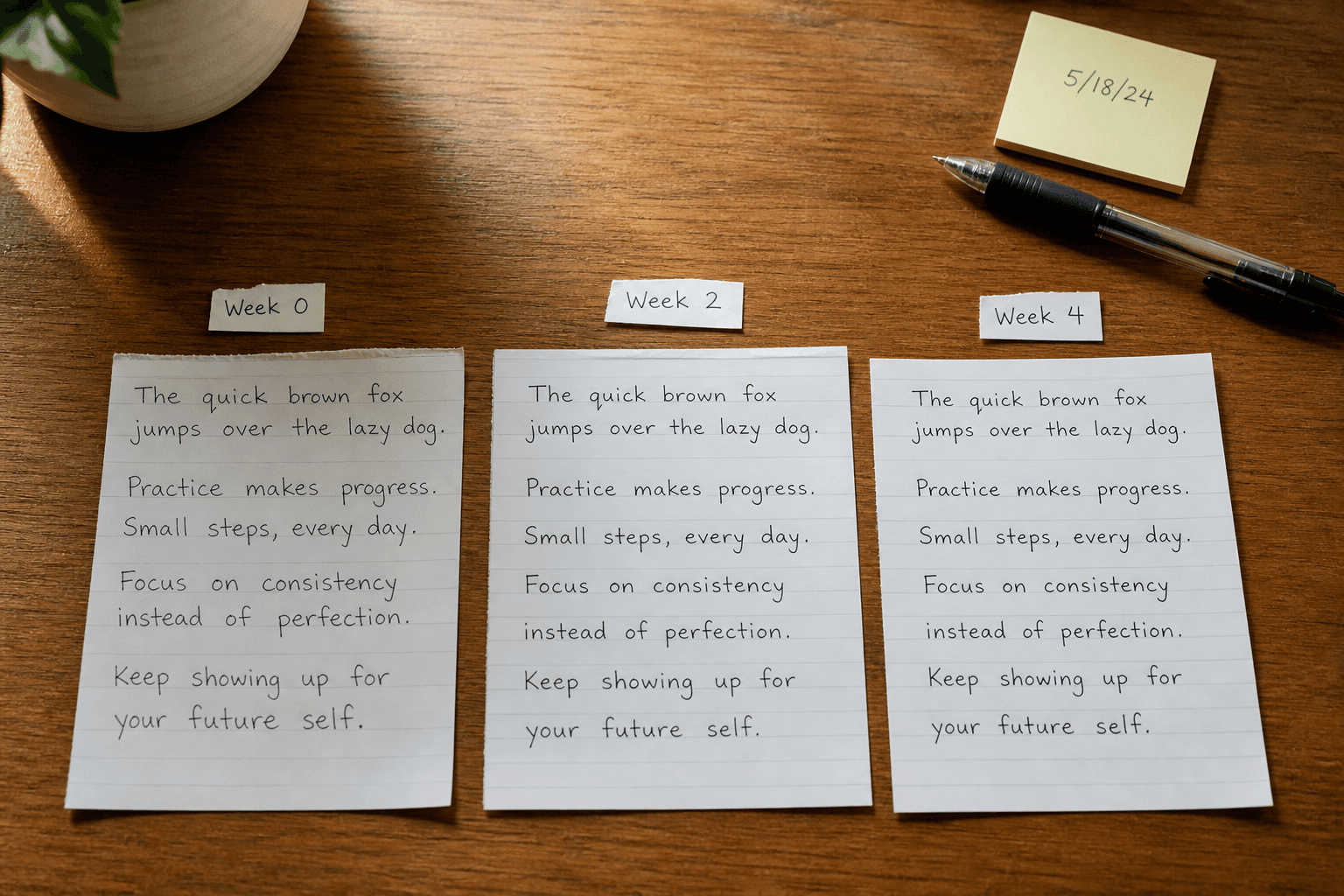
A good starter passage is two or three sentences with a mix of tall letters, short letters, descenders, and common word spacing. The classic sentence “The quick brown fox jumps over the lazy dog” works, but you can also use something more natural, such as a short paragraph from your daily notes.
What metrics should you track for handwriting improvement?
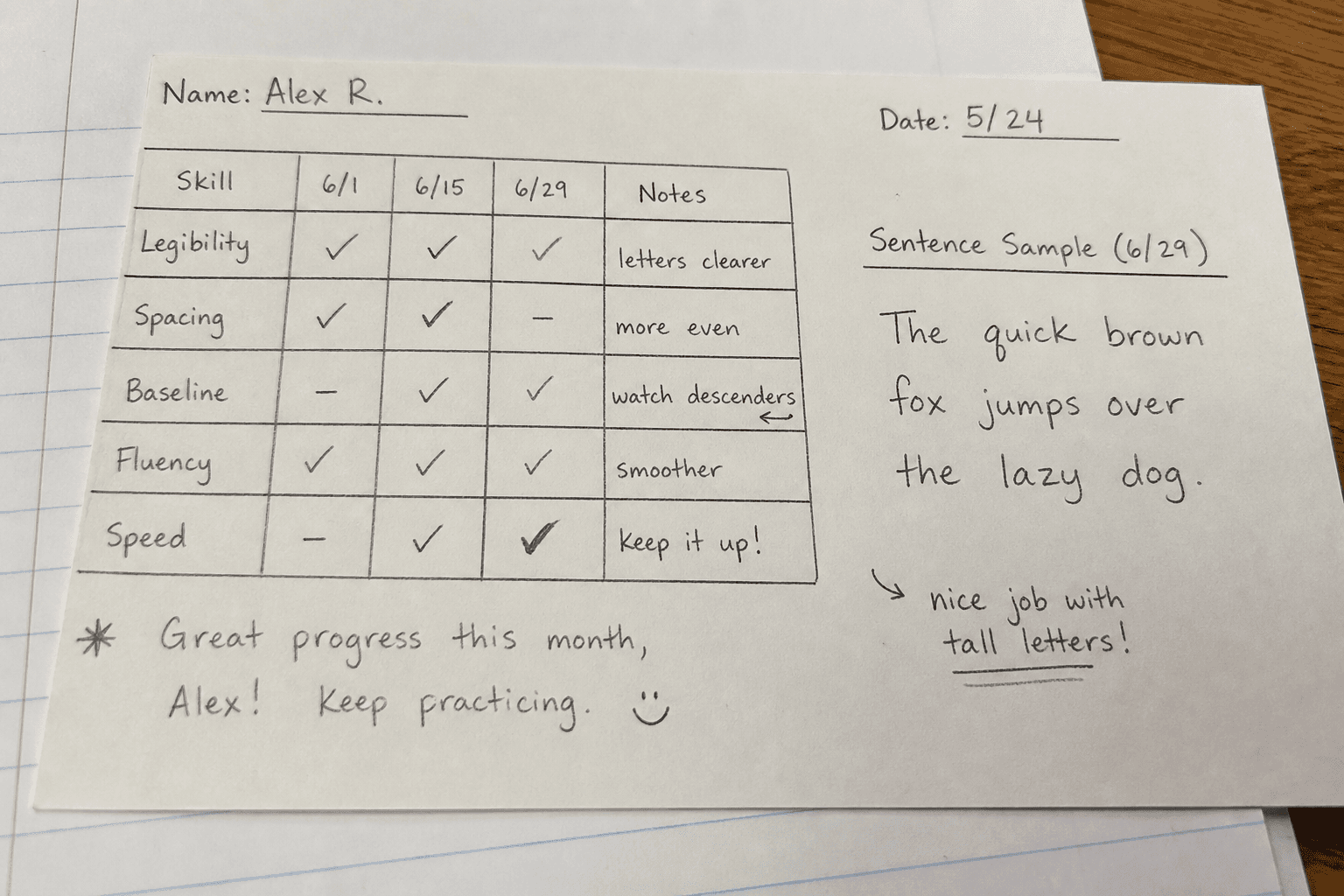
Track a small set of metrics that describe different parts of the writing, not one vague score for “neatness.” The most useful set for most learners is legibility, letter formation, spacing, baseline control, fluency, and speed.
- Legibility: Can a reader understand the words without stopping to decode them?
- Letter formation: Are letters shaped consistently enough that they do not turn into other letters?
- Spacing: Are spaces between letters and words predictable?
- Baseline control: Do words sit on the line, or do they drift upward and downward?
- Fluency: Do strokes look smooth, or do they appear shaky, patched, or restarted?
- Speed: How many readable words can you write in a fixed amount of time?
Do not collapse these into one number too early. Graham, Berninger, Weintraub, and Schafer found that speed and legibility do not develop in a simple parallel line. In practical terms, someone can become faster without becoming clearer, or clearer without becoming much faster. If you track only one metric, you can miss the real trade-off.
How do you build a handwriting progress portfolio?
A handwriting progress portfolio is simply a dated record of samples and scores. It can be a folder, a binder, a notebook, or a digital album. The format matters less than consistency. Each entry should include the writing sample, the date, the scoring notes, and one practice focus for the next review period.
Keep each review page to five lines of information: what passage was used, how long it took, the scores, the biggest visible improvement, and the next target. That last line is important. A portfolio is not a scrapbook. It should tell you what to practice next.
A simple portfolio entry
- Date: July 31
- Sample: same 3-sentence baseline paragraph
- Scores: legibility 3, spacing 2, baseline 3, fluency 2, speed 52 readable words per minute
- What improved: lowercase a and o are closing more reliably
- Next focus: word spacing during faster writing
If you need a more formal starting point, use our handwriting assessment rubric to define the first score set, then reuse the same dimensions during later reviews.
How often should you reassess handwriting progress?
Reassess handwriting every 2 to 4 weeks during active practice. That interval is long enough for repeated drills to change the sample, but short enough that you can still correct the practice plan before a weak habit settles in.
Daily scoring is tempting, but it usually creates frustration. Motor learning has normal variation. A sample written after a long school day may look worse than a sample written on a quiet morning, even if the underlying skill is improving. Checking too often makes that noise feel like failure.
If you are practicing with structured worksheet practice, use the portfolio review to decide which worksheets deserve another week. If spacing is improving but baseline control is not, switch the next block toward line control and alignment instead of repeating the same page out of habit.
What does the research say about handwriting improvement timelines?
The research is encouraging, but it also argues against magical timelines. Feder and Majnemer note that handwriting depends on many underlying skills, including fine motor control, visual-motor integration, attention, proprioception, and sensory awareness. That is why two writers can practice the same drill and improve at different speeds.
Case-Smith's school-based occupational therapy study is useful here because it separates letter legibility from speed. Students receiving occupational therapy improved more in letter legibility, while speed did not show the same positive intervention effect. For everyday practice, that means you should not assume a good plan improves every dimension at once.
More recent work on computerized handwriting evaluation points in the same direction. Chang and Yu show how handwriting can be evaluated through performance, motor control, speed, automation, and process features. You do not need a lab setup to borrow the lesson: better tracking comes from looking at several dimensions together.
If you want an extra check between portfolio reviews, an AI-powered handwriting evaluation can help score comparable samples across consistent dimensions. Use it as a measurement aid, not as a reason to skip the old-fashioned evidence of dated pages.
How do you know your handwriting practice is actually working?
Practice is working when the improvement survives normal writing conditions. A beautiful slow sample is nice, but it is not the whole goal. You want cleaner writing when you take notes, fill out a form, write a card, or copy something quickly without warming up for ten minutes.
Look for quiet signs of progress: fewer letters need rewriting, word spacing feels less forced, the baseline drifts less when you speed up, and other people ask for clarification less often. Those are not dramatic before-and-after moments. They are better. They mean the new habit is starting to show up without being staged.
Sources & References
Reviews why handwriting should be evaluated through both the visible written product and the underlying writing process.
Explains why handwriting competency depends on multiple motor, visual, sensory, and environmental factors.
Shows that handwriting speed and legibility do not improve in lockstep, which is why progress tracking needs more than one metric.
Demonstrates how structured handwriting evaluation can combine performance, motor control, speed, and process measures.
Reports that handwriting intervention can improve letter legibility, while speed may respond differently.