Quick Answer
How do you write faster without losing legibility?
Start with a repeatable timed sample, record words per minute, and have another person mark any words they cannot read. On later attempts, increase the pace by a small amount and keep it only when readability remains suitable for the task. Technique and setup changes are options to test, not guaranteed shortcuts.
Why does handwriting speed drop when you try to write faster?
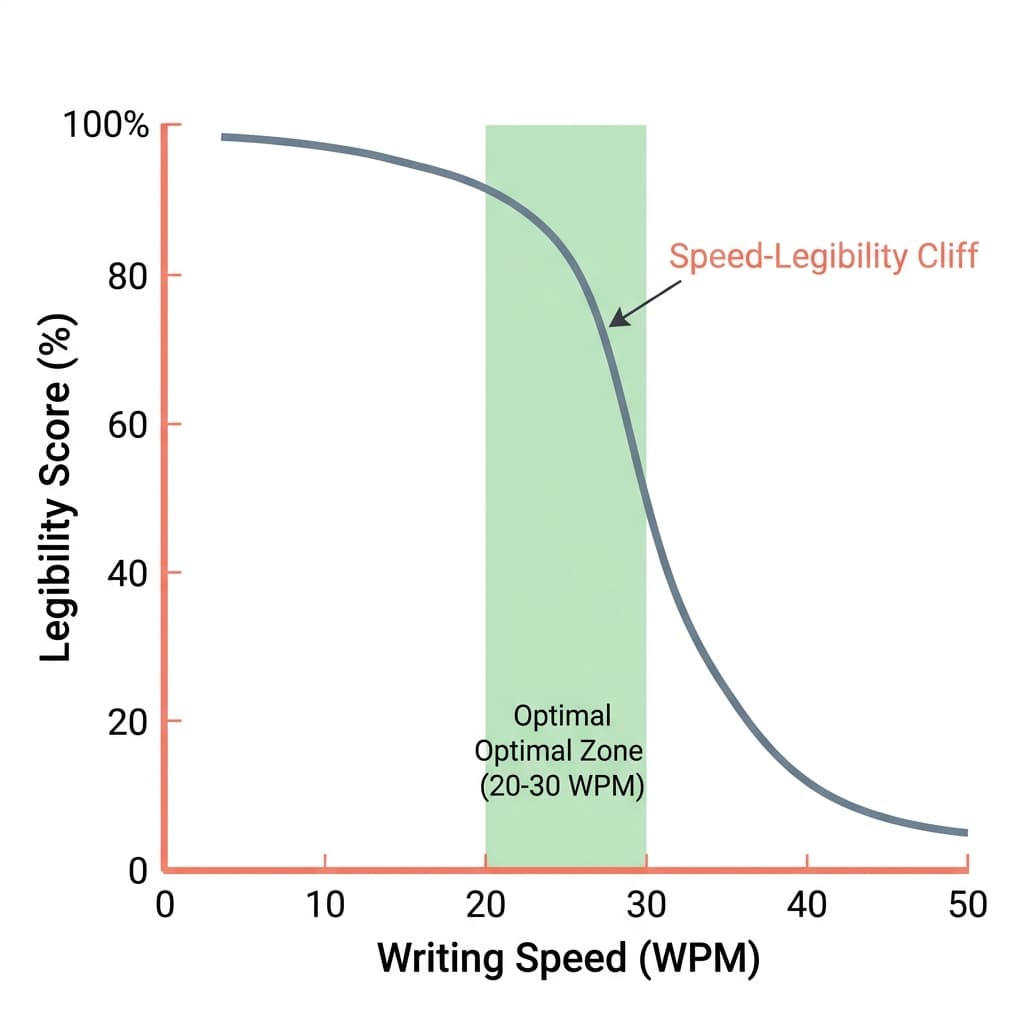
Faster aimed movements can become less accurate, but handwriting has no universal "speed-legibility cliff" at one WPM. The point where letters or spacing become difficult to read depends on the writer, task, passage, pen, and time pressure. That is why a useful speed test records both output and readability under the same conditions.
Have you ever tried to jot down notes during a fast-paced meeting or an exam, only to look down and find an unreadable sample? Under time pressure, writers may simplify letter shapes, crowd words, or skip corrections. Those visible changes identify where readability begins to fall; they do not by themselves reveal a single neurological cause.
Use your first sample as a baseline rather than comparing it with a generic adult target. If a slightly faster attempt remains readable, that pace may be useful. If important words become ambiguous, reduce the target or adjust one observable feature before testing again.
What techniques make handwriting faster without losing quality?
Three adjustments are worth testing one at a time: remove unnecessary pauses, make repeated letters more consistent, and place the paper where the writing line is easy to see. None guarantees an immediate speed increase, so compare each change against the same timed passage and discard it if readability or comfort gets worse.
Start by keeping letter size and spacing reasonably consistent. If your sample uses unusually large letters or elaborate loops, try a slightly more compact version while preserving distinct shapes. Structured print practice sheets can provide repeatable line and size guides for that comparison.
Also check comfort. If you notice sustained pinching or discomfort, try less pressure, a wider or smoother-flowing pen, forearm support, or a different paper angle. There is no required grip name or exact rotation angle; keep the setup that supports comfortable, readable writing.
What are the best drills to improve handwriting speed?
The following drills are practical measurement protocols, not trial-validated prescriptions. A timed copy establishes a repeatable baseline. A speed ladder tests a small increase from your own baseline. A real-world simulation checks whether the pace transfers to meeting notes, exam essays, or journaling. Each drill records both speed and reader-checked legibility.
The easiest drill to start with is the Timed Copy Drill:
- Use the fixed copy passage and timer below, or choose a passage and a phone timer.
- Start with your pen ready. Keep the passage, pen, paper and style the same on later attempts.
- Copy at a comfortable pace and stop at 60 seconds, or stop the timer if you finish sooner.
- Count complete words. WPM = complete words × 60 ÷ elapsed seconds.
- Scan your writing and circle any letters that look ambiguous (like an 'o' that looks like a 'u').
Try a one-minute handwriting speed self-test
Copy the passage on paper in your usual handwriting. Start when your pen is ready; stop at 60 seconds, or press Stop if you finish sooner. Count complete words only, then record how easy the sample is to read.
This is a personal practice baseline, not a standardized or clinical assessment. The timer has no sound; keep it visible. A phone timer is an alternative if you need an audible signal.
Fixed copy passage · 100 words
A quiet morning gives me time to plan the day. I open my notebook and write a short list of things to do. First, I will finish one small task before starting another. Then I will take a break and look at what I have written. Clear letters and spaces help me read my notes later. I do not need to rush every line. A steady pace lets me notice the shape of each word. When the page is complete, I can compare it with an earlier sample and choose one useful change for my next practice session at home.
Ready. Keep the same pen, paper and passage for later comparisons.
Enter 1–100. Exclude unfinished words. WPM = complete words × 60 ÷ elapsed seconds. Samples shorter than one second cannot be calculated.
Entries stay in this page while it is open and clear on reset, a new sample or reload. Your word count, WPM and readability selection are not sent to analytics. The result is not automatically saved or transferred.
Keep a baseline and compare later samples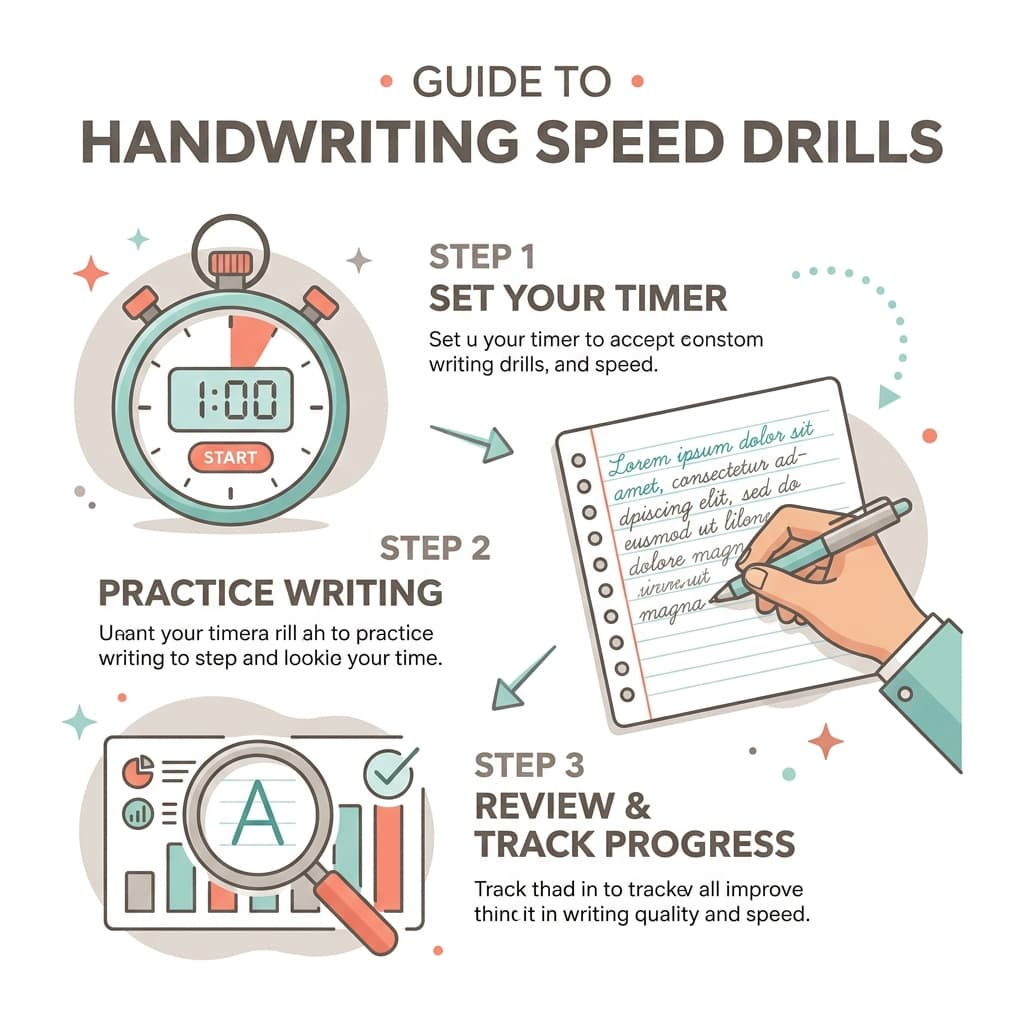
The goal is to find a useful legibility boundary for your task. Ask another reader to mark ambiguous words without seeing your previous score. Increase the target only after the current sample meets the readability requirement you chose in advance; the cited evidence does not establish a universal 5% error cutoff.
How do different handwriting styles affect writing speed?
Keep your current style constant while testing speed so that you do not change two variables at once. Connected, semi-connected, and print writing can differ in pen lifts and letter construction, but the sources cited here do not establish a universal winner, percentage advantage, or adaptation timeline.
Choosing between styles is a separate question from improving speed within your existing style. Use the cursive-versus-print speed and legibility comparison for the research and comparison protocol; return here after choosing the style you actually want to measure.
How do you measure and track handwriting speed improvement?
Effective speed tracking requires measuring two variables simultaneously: words per minute (WPM) and readability. Time the same passage, record how many complete words you wrote, and ask another reader to mark anything ambiguous. Save the passage, duration, pen, and setting with the result. Use the same manual categories each time: all words readable, some words unclear, or many words unclear. These observations help you compare your samples; they are not a standardized assessment.
You can't improve what you don't measure. Try timing yourself once a week and recording your result. If WPM rises while more words become ambiguous, the new pace does not yet meet your readability requirement. As an optional second set of observations, you can scan a practice page and use our AI handwriting evaluation tool.
The tool reports visible dimensions such as letter formation, baseline use, size, and spacing. Treat that output as a non-clinical comparison aid, not an objective proof of fluency or a replacement for the reader check. None of the cited sources validates this exact drill sequence, WPM threshold, or fixed improvement timeline.
Frequently asked questions
How do I calculate handwriting words per minute?
Count complete words and multiply by 60, then divide by elapsed seconds. The self-test on this page supplies a fixed passage and a timer that stops at 60 seconds, or sooner if you press Stop. Record a separate readability check; this is a personal practice baseline, not a standardized assessment.
What's a realistic handwriting speed goal for adults?
There is no single evidence-backed WPM target that fits every adult, task, and handwriting style. Measure your own baseline with the same passage and time limit, then test a modestly faster pace while checking whether another person can still read the sample.
How long should I practice speed drills each day?
Use a short, repeatable block that lets you compare samples under similar conditions. Stop or split the session if discomfort appears or letter forms become difficult to read. The cited research does not establish one daily dose or improvement timeline.
Does writing faster always mean messier handwriting?
Not always. The speed-accuracy trade-off differs by person and task, so compare both WPM and readability instead of assuming that every increase helps or harms. Keep only a faster pace that still meets the readability requirement for your real task.
Sources & References
Presents a broad theory of speed-accuracy trade-offs in rapid aimed movements. It is not a handwriting training trial and does not establish an adult WPM target or practice schedule.
Reports an association between undergraduate handwriting speed and exam-essay performance. It does not test the drills, dose, or improvement timeline in this guide.
Reviews why fluent transcription can matter in adult writing. It does not prescribe a universal speed goal or show a fixed percentage gain from training.
Found no speed or legibility differences among four mature grasp patterns in a 10-minute Grade 4 copy task. The child sample does not establish an adult fatigue treatment.