Pick a practice style from the writing job you actually have—notes, exams, journals, or workplace documents—not from a single “best font” claim.
There is no absolute best style. A fast note script can hurt exam grading; an elegant journal hand can be the wrong tool for forms. Ask: what do you write for?
If your letter structure is still unstable, start with the handwriting hierarchy (print before continuous cursive). If you want measured print/cursive/hybrid trade-offs, open the speed and legibility benchmark. This page only maps scenarios to a practice choice.
Which Handwriting Style is Best for Note-Taking and Speed?
The Short Answer: For taking fast notes during meetings or lectures, an Italic cursive or a personalized Mixed script is generally the best choice. These styles maintain crucial letter connections for speed while dropping overly complex loops, ensuring your notes remain highly legible even when written rapidly.
If your pain point is keeping up in meetings or lectures, do not memorize every conventional ligature by default. For readable speed, prefer a semi-connected italic or a personal mixed script over ornate continuous cursive.
Evidence for throughput/legibility trade-offs lives on the print vs cursive benchmark; italic join mechanics live on italic vs conventional cursive efficiency. Here the decision is simply: notes → prioritize selective joins over decoration.
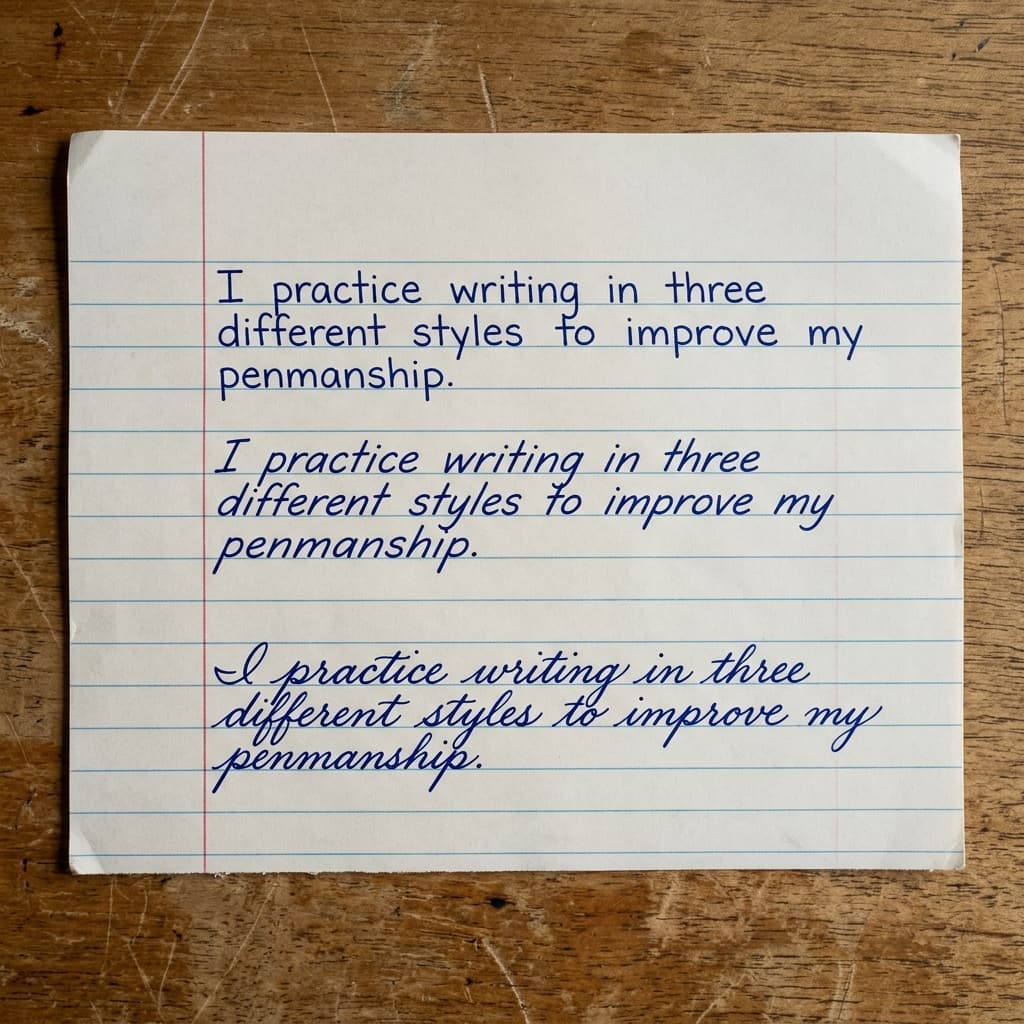
Which Style is Best for Personal Journals, Letters, and Signatures?
The Short Answer: For personal expression, aesthetic appeal, and signature design, traditional Cursive is unmatched. It offers an elegant, continuous flow that looks mature and beautiful, while the uninterrupted motor movement helps writers enter a state of deep focus or "flow" during journaling.
While a Mixed script dominates the boardroom, in the realm of personal expression, Cursive remains the undisputed king.
If you are writing a heartfelt thank-you letter, keeping a daily journal, or looking to develop a highly recognizable adult signature, Cursive is absolutely worth the time investment.
- Aesthetic Pleasure: A line of well-executed, consistently slanted cursive looks incredibly elegant and mature—an artistic quality that standard Print rarely achieves.
- Focus and Flow: Cursive emphasizes continuous pen movement. This uninterrupted physical action makes it easier to enter a "flow state," perfect for deep thinking and late-night journaling.
- Continuous practice: Fluent joins also transfer to short personal marks, but this page is not a signature-design tutorial.
If you want to start building this foundation, you can use our Cursive Handwriting Worksheets generator to create daily practice drills for continuous ligatures. Nothing puts your personality onto paper quite like Cursive.
What is the Best Handwriting Style for Exams and Academic Tests?
The Short Answer: The best handwriting style for exams is clear Print (Manuscript) or a highly controlled Semi-cursive. In academic testing, your primary goal is zero-friction readability for the examiner; any style that forces the grader to pause and decipher your words will negatively impact your score.
If you are a student, your "target audience" is an exhausted examiner grading hundreds of papers under extreme time pressure and fatigue.
In this environment, it does not matter how artistic or sweeping your cursive is. If the grader cannot accurately identify your word within 3 seconds, you lose points. In an exam, Legibility is literally the grade itself.
If you are facing a critical exam, you must read this engineering analysis of test environments before picking a practice style:
👉 How Legibility Engineering Affects Exam Scores
Your goal isn't to write "fancy," but to create zero reading friction. We recommend using our Print Handwriting Worksheets to train highly standardized, widely recognizable letterforms before test day.
How Should You Write in a Professional Workplace?
The Short Answer: The most practical approach for the workplace is a "dual system": use standard Print for external-facing documents (like forms, labels, and whiteboards) to guarantee clarity, and develop a personalized Mixed script for internal use (like rapid meeting notes) to maintain speed.
In an office, your writing is meant for colleagues, clients, or management. Workplace handwriting has two extremes: scenarios demanding 100% accuracy (like filling out legal forms or labeling) and scenarios demanding extreme speed (like brainstorming on a whiteboard).
For professionals, the most pragmatic strategy is the Dual System:
- External Output: Stick to Print (Manuscript). It is safe, professional, and has zero barrier to entry for any reader.
- Internal Logging: Cultivate a fast Mixed style that only needs to be readable by one person: you.
How Can AI Help You Choose Your Handwriting Style?
The Short Answer: Instead of guessing which style to learn, an AI handwriting analysis tool reviews visible features in a writing sample. The Full Report recommends practice fonts across print, cursive, and italic styles, explains writing issues, and links to matching worksheet practice. These are educational suggestions rather than a prescribed daily training schedule.
If you have read through these scenarios and are still torn between Print, Italic, and Cursive, please stop guessing.
You don't have to start from scratch and adapt to a totally alien font. Your current motor memory, grip habits, and stroke patterns dictate which style you are already naturally closest to.
You can use our AI Handwriting Analysis to take the guesswork out of your training:
- Assess the Baseline: Upload a sample of your natural writing. The AI will pinpoint your visible letter forms, spacing, and core writing issues.
- Smart Recommendations: The Full Report recommends Target Fonts across print, cursive, and italic styles, with reasons based on the submitted sample. Preview a style before choosing it for practice.
- Practice Handoff: Choose a recommended font to open a matching worksheet generator. Adjust the text and practice amount yourself; the report does not guarantee a daily schedule or an improvement outcome.
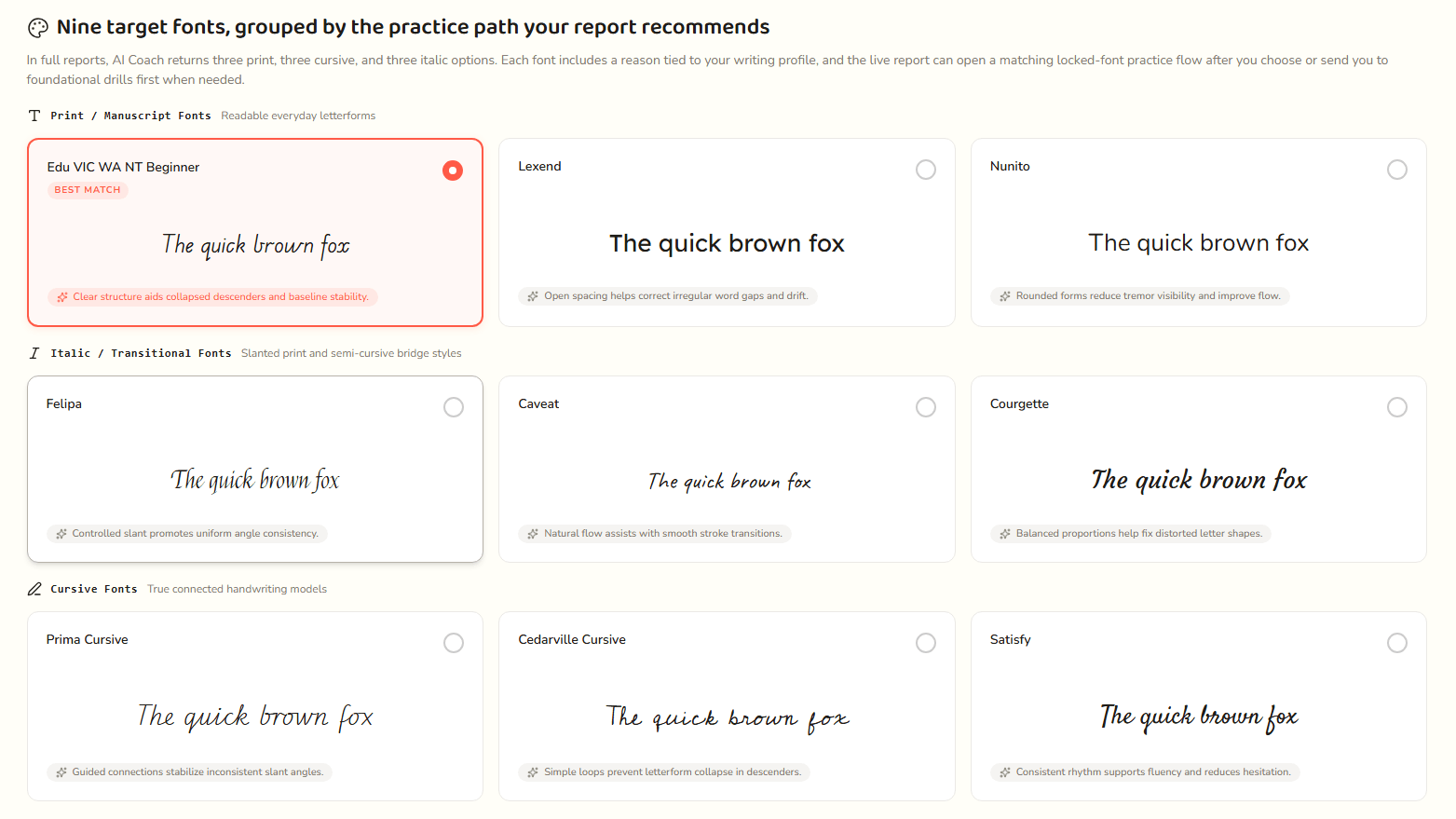
Finding a style that genuinely aligns with your hand's natural tendencies is the single most important first step to better writing. Let data guide you, and the practice will feel effortless.
Frequently asked questions
Is it too late to change my handwriting style as an adult?
No. Adult motor learning can still reshape letter habits. Give a scenario-matched style a few weeks of short, targeted practice before judging whether it fits.
Can I use more than one handwriting style?
Yes. Many adults use clear print for public-facing forms or labels and a faster mixed or italic script for internal notes.
Sources & References
Supports scenario choice: mixed/hybrid styles often balance throughput and legibility—numbers live on the benchmark page; this page only maps jobs to practice picks.
Shows transcription load affects composition under time pressure—relevant when choosing exam vs note-taking scripts.
Reminder that style choice assumes basic letter competency; unstable structure should start with hierarchy/print practice first.