Quick Answer
How can left-handed writers avoid smudging?
The smudge problem is a physics issue, not a skill issue. Three fixes work: (1) tilt the paper 30–45° clockwise so your hand writes below the line, (2) use quick-drying ink (gel pens with 0.5mm tips), and (3) adopt an underwriting hand position instead of the common hook grip.
In the world of handwriting, lefties often feel like they are fighting against their own biology. The ink smudges, the paper tears, and the hand cramps. This is not a talent issue. It is a physics issue caused by the push-pull asymmetry between left and right-handed writing mechanics.
Why Does Left-Handed Writing Create More Friction Than Right-Handed Writing?
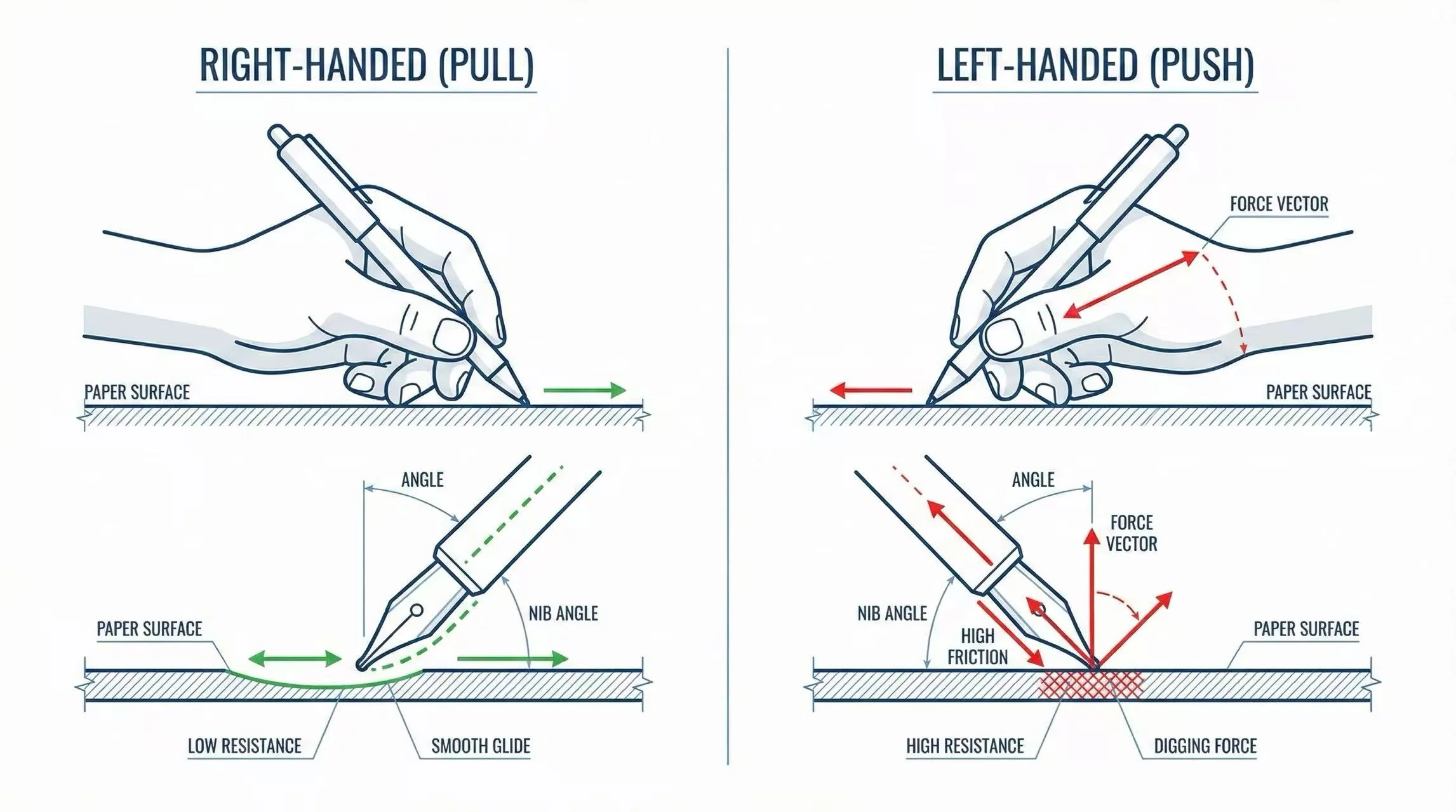
Before fixing the issue, we must understand why left-handed writing feels “laggy” and prone to errors. According to clinical guidelines from the NHS (National Health Service) , the direction of the stroke fundamentally alters the stress on the pen nib.
Vector Analysis:
- Right-Handed (Pulling): The hand drags the pen. Resistance is low, ink flows smoothly.
- Left-Handed (Pushing): The hand pushes the nib into the paper fibers.
The Consequence: Pushing creates a downward force vector, drastically increasing friction (Ffriction). It’s like petting a cat backwards—causing skipped ink and scratched paper.
How Do You Rotate Paper for Left-Handed Writing Comfort?
Many lefties adopt the “Hook Style” (curving the hand around the top) to see what they are writing. Ergonomically, this is a “buggy workaround” that forces the wrist into extreme flexion, increasing the risk of Carpal Tunnel Syndrome (CTS).
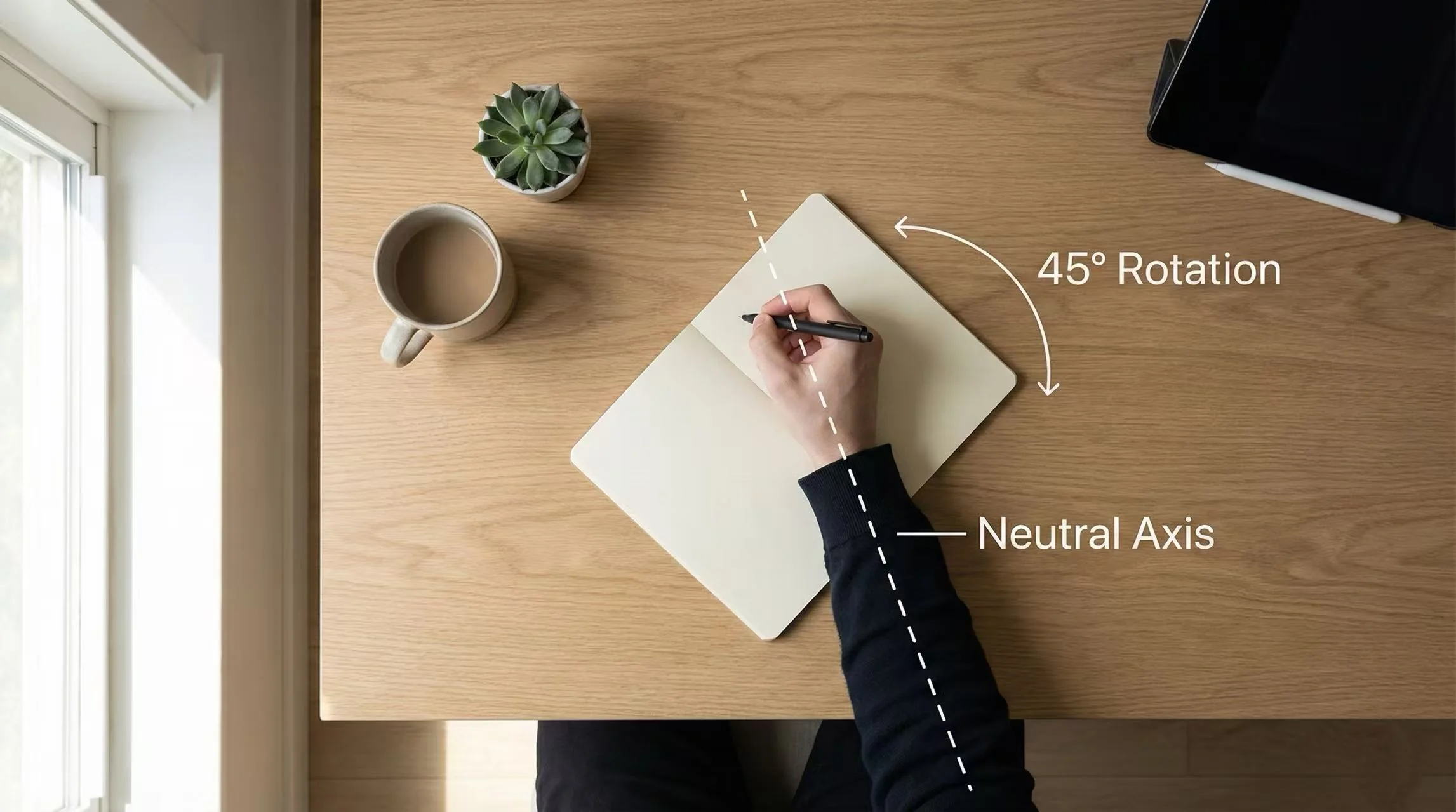
The correct fix is to rotate the coordinate system (the paper), not your hardware (your hand). This aligns with the “Neutral Wrist” principles advocated by Cornell University Ergonomics .
Execution Protocol:
- Reset Position: Place your arm naturally on the desk. Do not bend your wrist.
- Rotate Paper: rotate the paper clockwise by 30° to 45°. Data from Teach Handwriting suggests this angle maximizes visibility while maintaining comfort.
- Refactor Vision: You are now writing “up and to the right” relative to your body, but straight across relative to the paper.
What Grid Settings Work Best for Left-Handed Paper Rotation?
Standard practice sheets are designed for right-handed “pull” strokes, often featuring a right-leaning slant. If you use these on a rotated paper, your letters will topple backward.
You need to recompile your training data. Use our Line Generator to create a grid specifically for this patch.
| Your Style | Paper Rotation | Generator Setting | Physics Reasoning |
|---|---|---|---|
| Print (Block) | 45° Clockwise | Vertical Line | With paper rotated, vertical lines act as diagonal guides, keeping letters upright. |
| Cursive | 30° - 45° | Left Slant Line | Counteracts the “push” resistance by aligning with natural arm movement. |
| Drills | Any | Counter-clockwise Oval | Mechanically easier for the left hand (pushing outward) to build muscle memory. |
How Can You Test If the Paper Rotation Fix Is Working for You?
How do you know if the patch is working? Don't rely on feelings (feelings are unreliable variables); rely on data.
Although our AI cannot see your wrist angle, it can detect the rendering artifacts caused by bad posture (smudges, inconsistent slant).
- A/B Test: Write one sentence with your old “Hook Style” and one with the “Rotation Patch.”
- Success Metric: Check the Legibility Score in our Analysis Tool. A higher score indicates that the “Smudge Bug” is resolved.
How Can You Start Optimizing Your Left-Handed Writing Setup?
Left-handed handwriting doesn't need to be a struggle. By understanding the physics of Push vs. Pull and applying the 45° Rotation Patch, you are optimizing your writing environment for your specific hardware.
Generate Your Left-Handed Grid
Ready to apply the patch? Create a custom worksheet with Vertical or Left Slant guides now.
Frequently asked questions
How can left-handed writers avoid smudging?
The smudge problem is a physics issue, not a skill issue. Three fixes work: (1) tilt the paper 30–45° clockwise so your hand writes below the line, (2) use quick-drying ink (gel pens with 0.5mm tips), and (3) adopt an underwriting hand position instead of the common hook grip.
Sources & References
Clinical guidance on left-handed stroke direction, grip posture, and practical classroom accommodations for smudge and friction issues.
Neutral-wrist and workstation positioning principles used here to argue against hook-grip workarounds.
Practical paper-tilt guidance (about 30–45°) for left-handed writers to keep the hand below the writing line.